When comedy legend Patton Oswalt appeared on the Good One podcast in 2018, he spotlighted Gary Gulman’s “state abbreviations” routine as a “killer” bit he wished he’d written himself. A delightfully absurd six-minute roller coaster ride of a joke, Gulman easily won over the crowd when he performed it on Conan two years earlier, but it was Oswalt’s endorsement that helped the bit truly take off.
Gulman could’ve followed up the quirky clip’s viral success with similarly rambling silliness, but instead, his next special was devoted entirely to his struggle with depression and the treatment that helped him move forward. The Great Depresh (streaming now on HBO Max) is a hilarious, poignant masterpiece that challenges the norms of stand-up specials in many ways, supplementing Gulman’s performance with vignettes that explore his mental health journey further.
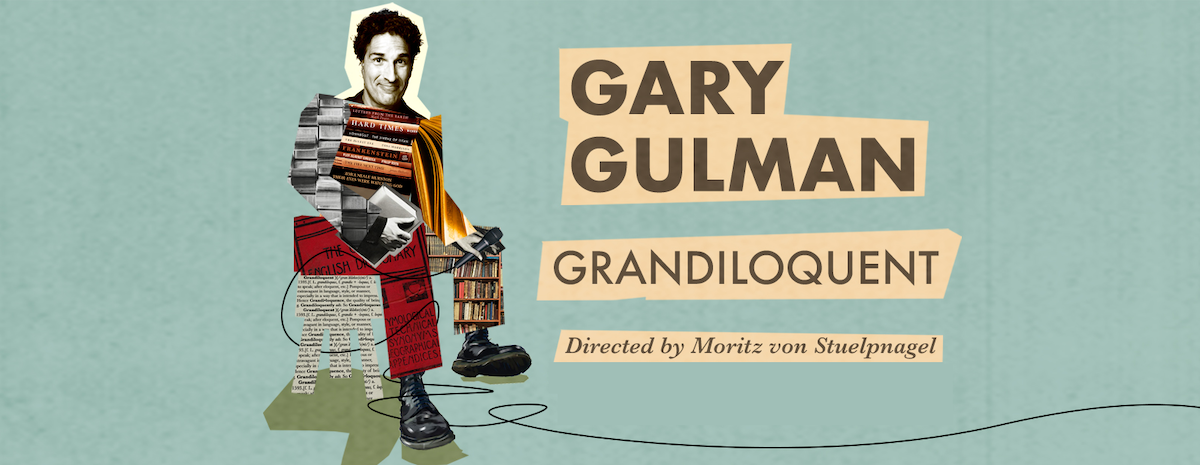
That willingness to get vulnerable is even more on display in Grandiloquent, Gulman’s one-man show, which he brings to the Athenaeum Center this Saturday. We talked to Gary about the trajectory from his Last Comic Standing stint over 20 years ago to Grandiloquent, his love of reading and language, and take the obligatory detour into dissecting how Missouri ended up with the worst state abbreviation of them all.
This is really a treat for me, because I’ve been a fan of yours since the Last Comic Standing days.
Wow, you must have been a kid.
I think I was 12 or 13 when it started.
Thank you, that's so nice to hear.
Two decades down the line, what are your memories of the whole Last Comic Standing experience?
I just remember I was feeling pretty good at the time, and I really had nothing going on in terms of my career. I couldn't get any road work, and, this sounds like an exaggeration, but I don't think I had $300 in the bank when it started. I just remember I went into more credit card debt to buy clothes so that I could I could look good on TV, and then I just kept getting passed further along, and it was really exciting.
It was interesting because it gave me a touring career for about a year and a half, and then it was back to where I was; it was like going back to the beginning. It was a little bit frustrating. I mean, most people never get to have that kind of exposure, so I was grateful for it, but it was also like, ‘Oh, it didn't set you up for the rest of your life in terms of touring,’ whereas it turns out that it was it was an appearance on Conan that kind of set me up for that. Specifically, Patton Oswalt shared my appearance on Conan where I talked about abbreviating the 50 states, and and that gave me a foundation that I feel like has grown, but it was strong enough just on that that I could tour the country and pay my rent every month, which is really, as you know, all we want as a comedian, to be able to give it our all and not have to split our energy and our brainpower with a day job all the time, so that was that was really helpful.
We’ll definitely dive more into that Conan appearance and the 50 states abbreviation bit later. But fast-forwarding from Last Comic Standing, tell us what audiences should expect from Grandiloquent, which you’re bringing to Chicago’s Athenaeum Center on September 20.
It is, in some ways, sort of an origin story for my style of comedy, but also an origin style for a number of my personality traits and a number of my neuroses. It's a little bit of a prequel to The Great Depresh, but it's a little bit more theatrical in that it's not all hilarious stand-up. This has some stories that are real bummers, so it was more of a challenge to perform it, because our oxygen as comedians is laughter, and there's a part where it's hard to say whether the audience is enjoying themselves, because it's not a very funny story. It’s sad, and it's just straight information rather than a joke or a witty comment, so it was challenging, but not so challenging that I was overwhelmed.
I felt over my head when we were rehearsing it, and that's a really good place to be as an artist or an athlete or really anything. You should give yourself enough of a challenge where you wonder whether you're equipped and whether you'll be able to rise to the occasion. So I think that the show is really fulfilling. I mean, it was critically acclaimed, but I think more importantly, it was a little bit out of my comfort zone. My comfort zone is saying funny things, and this involved me not being funny for part of it. It's still a comedy show, but there's a lengthy story about a half-hour in that people gasp about and really take away with them. I think it's sort of a gradual evolution as a performer and writer, to start just doing these observational jokes and then do something very personal with The Great Depresh, and then to do this, which is personal and also out of my comfort zone in terms of acting and performing. So I got a lot out of this, and the audiences—there was a real connection there. I think I always connected with my audience, but this was a different, even deeper connection than I'm used to. I'm really proud of it.
Do you feel like it’s a natural evolution from The Great Depresh?
Yeah. I was fortunate enough when I did The Great Depresh to have an audience that was patient and trusted me and knew I was professional and thoughtful, so they would see something from me that wasn't my usual show, which was mainly just observations and some absurdity and some stories. Grandiloquent is probably the same amount of personal as The Great Depresh, but with The Great Depresh, I was able to get a lot of the deeper stuff out that wasn’t as funny in a documentary portion of the show, so essentially I didn’t have to be there when the people weren’t laughing.
I think as a performer, you’re most vulnerable just being yourself. It doesn’t have to be a deep secret or a private moment. It’s very vulnerable to go up there and say, ‘I think this is funny and I think you should think this is funny,’ and you don’t know whether they’re gonna laugh, but eventually you figure out whether it’s funny, and it gets less vulnerable, but with every new audience, there’s always that bit of anticipation and a little bit of anxiety over that, and it makes it fun.
It’s like, when I play basketball, if I made every shot, I think I would be happy, but in reality, it would probably get boring. When you get into a video game or some sort of skill, and it gets to a point where, ‘Well, this isn't very challenging,’ you lose interest. I think that's part of the trick to staying interested in comedy, because I've been doing it 32 years now and it remains challenging, and it can be humbling at times, and I think that's part of the equation, and I think that's maybe why—and we all know comedians who've been doing the same act for decades—why they they burn out or get bored or just throw in the towel or whatever.
And I don’t want to ignore the follow-up to The Great Depresh, 2023’s Born on Third Base. What was its role in the process towards Grandiloquent?
What I found after The Great Depresh was that I usually move towards a theme for the entire show, and the theme that kept getting me excited and inspired me was that of income inequality and poverty. I was reading a lot of books about that, and I was really interested in that, so that brought about what became Born on Third Base, and then I wrote a book about my life from first grade to 12th grade. I was writing the book while I was doing Born on Third Base, and then I had to prepare a show to tour with the book because I didn't—I'm not like David Sedaris, where people just want to hear me read from the book and tell a few stories, so I needed to write a stand-up show, and I quickly realized that the stand-up show that I was doing would lend itself nicely to a one-person show, and then I started working on that with a director that I met (Moritz von Stuelpnagel). We found a really great creative partnership, and so that was really helpful. That was another lesson I learned from The Great Depresh, how you can really leverage your talent by adding another person to it, and another ear, and also input another brain, so that was really fulfilling and satisfying to work with Moritz.
Earlier in our conversation, you referenced the vignettes in The Great Depresh—you have scenes with your doctor, with your wife, with friends, interspersed within the stand-up performance. How did you decide the best way to tell that story in a way that was fulfilling for both the studio audience and the audience at home?
The answer is Mike Bonfiglio, the director. When we started working on the show together, I would send him my recordings, mostly audio recordings from shows I was doing on the road, where I was working in jokes and stories about my treatment and my illness, and then at one point, when we said, ‘Alright, this is what we're going with in terms of the jokes; now we need to develop an order so that we can tell this story through documentary footage,’ and so until I saw the first edits, I didn't know that we were cutting from a joke to a clip. I mean, some of them were obvious, but others were very inspired. By obvious, I mean, I’m talking about ECT (electroconvulsive therapy) onstage, and then we go to me trying it out for the first time and being interviewed about that. So that made sense that it would go there, but other things were just really inspired choices by Mike.
We developed it together. I wrote all the jokes, but he would say, “Can you add some jokes about the hospital stay? Can you talk about your childhood experience with depressive symptoms?” He was such a great guy and he's a great storyteller in in film, and I think that really helped make me a better storyteller in terms of my my stand-up, because we were trying to do a narrative arc, and that's something you don't really think about when you're doing stand-up—maybe within the jokes you do, but you don't really consider it when you're writing an hour or hour and 15 minute act, so that was that was really helpful.
The vignettes do such a great job enhancing what is already great storytelling onstage. How did you tackle the challenge of writing jokes “on demand” in a sense, with Mike providing direction on where to take your material?
I was truly fortunate in that I was feeling so good after I started to feel better, and I changed my entire approach to writing. It used to be, ‘If this audience doesn't like this joke, it'll be the death of me and I'll never recover and it'll be so humiliating,’ and that makes you very cautious and it keeps you from really trying things. And then it became, ‘Even if this fails, it may get me closer to what I want, so I'll just try and think of something else, and I won't be so precious with my creativity.’ When I first started doing comedy, the voices that were sort of guiding us were people like Jay Leno and Jerry Seinfeld, who had a philosophy that you only get about an hour of material in your entire life, so you have to keep it to yourself and not let it get out there, because it's so limited. And some other comedians, including Patton Oswalt and Maria Bamford, proved that you can keep writing and expand your act and change and evolve. (Seinfeld and Leno had) good business advice, I guess, which is what it turns out those guys are. They’re primarily businessmen. They're not—to me, they're not artists, but it's terrible advice for an artist, and it's so limiting.
So to get back to the question, I had about 15 or 20 minutes of material about my treatment and my depression, and then Mike would say, “Can you write something about this?” and I had nothing to lose anymore because I didn't put my self-esteem as the anti to trying out a new joke. I just was trying out new jokes, and some of them worked right away, and some of them didn't, but then you get to work, and it gives you confidence, and I also have this person who was so encouraging and very gentle with criticism. He wouldn't say, “That's not good.” He would say, “We don't need that.” And the other thing he said was, “If you can't find something funny, we'll just say it in the documentary. We'll get the information out there. You don't need to rely on the jokes for exposition,” which is really a lot of what a stand-up show is. You want to get your life across, but you need these jokes to get the exposition out there, and so it can be limiting. So that really freed me up to know that the show wasn't dependent on me writing funny things about the depression and electroconvulsive therapy, that we could get the information out elsewhere, and it was just such a great partnership.
Letting go of having your self-esteem rely on the success of your act has to be freeing.
That took me until 2017. I started in ‘93—that’s 24 years to figure out this thing that I wish I figured out a lot sooner, but you live and learn.
One thing that really struck me in the Great Depresh vignette with your friend and fellow comic, Robert Kelly, was the conversation about how so many comics who battle depression feel like they need to experience that sadness to be funny. Why do you think that belief is so prevalent in the comedy community?
I think it's natural to want to think that your pain and suffering has purpose, and I think you can find some silver lining or some meaning in it. It could motivate you; it could make you more empathetic towards people who are suffering. I think most people have enough suffering inventoried to draw on it to make good art. I will say that I don’t know that I’d be as vigilant about my mental health if I hadn't fallen so deeply, so that might be a helpful thing, that it was so bad that I never want to get back there. Any time I start feeling that way, I do the things that got me out of it, so there's that, but I also think that a lot of artists and a lot of comedians are very sensitive, and so we take the world in a different way than maybe the average person does. We’re sensitive, we’re irritable, and we love words usually, so that combination is powerful, but it can also be very, very painful.
But I want to make a distinction between being sad, suffering, and having mental illness. Mental illness is a biological thing that requires an intervention, and in my case, it was chemical, and it was talk therapy. I couldn't get any work done. I mean, that's the most important thing that I would say, is that, as ultimately interesting as it was (to tell that story), I couldn't have written about it if I had stayed in it. I could only write and perform with any clarity when I was outside of it, because it was that debilitating and that severe.
The fact that The Great Depresh resonated with so many people, just like the abbreviating the states joke, is just luck. You write what excites you, and you write personal things, and then you throw it over the fence, and if people connect with it, great, but tying yourself to that outcome is really dangerous, and it was something I did for so long, and it ultimately drove me mad.
You mentioned your love of words, and I have to say, you are maybe the most linguistics nerd-friendly comedian out there today. You have so many bits that you spice up with strategically placed antiquated phrases—I’m thinking of “ne’er-do-well” in the abbreviating the states bit specifically. Where do you pull those from, and how do you know where to place them in a joke for maximum amusement?
It's from reading so much. I read more than just about every other comedian. I think I've read 60 books already this year, and I’ll probably finish close to a hundred, and that's been every year that I haven't been sick. I also listen to a lot of books. I had a friend who sadly passed away, but he was very literate. He was an English teacher and a comedian—a high school English teacher, which is really hard. He was so well-read. He said something that put words to what I knew intuitively: people love to hear words that they forgot they knew.
That’s what I realized I had been doing, and I try to continue to do it. But there's a sweet spot, and that comes from trial and error. You try this word, you try that word. Sometimes you get to the stage and you're about to say one word and think, ‘Oh, they're going to groan at this because it's way too written,’ so you dial it back. But if you've spent as much time as I do writing out the sentences and switching the words so many times, you remember which word was the second least obnoxious. You can go to that.
It's trial and error, but after 30 years, you build up instincts as to what will land and what won't, what will sound too written. I don't want to be the comedian who the audience is silent for—that’s painful. But I don't mind if every once in a while a word doesn't land with that audience, because when I do it on TV, it finds people who think, ‘I gotta see this guy live because he gets me.’ I forget who said it—I think it was a British comedian—who said if you can find a thousand people who will go to every show when you're near them and buy every album you put out, you can have a nice career. I don't know if it works out, but I also think there's nothing wrong with having a side hustle to keep stand-up going. For the first seven years of doing comedy, I had that. Then I was fortunate to get a development deal to make a sitcom that never got made. That was like podcasting in the 90s—you’d sell a sitcom idea and make a little extra money.
Another thing you do really well is hook audiences with stories that they quickly discover aren’t entirely accurate, but they still want to go along for the ride, like the Trader Joe’s bit and the state abbreviations bit. How do you keep the audience invested even when they know the bit isn’t completely authentic?
The Trader Joe’s story is true, with exaggerations. But abbreviating the states part didn’t work until they started making small documentaries about little things. That device changed people’s understanding, and yet some still believe it. (AUTHOR’S NOTE: There is not, in fact, a documentary about the team that created two-letter abbreviations for the 50 states.)
It was hard to build material for the first 20 years. The main reason was how difficult it was to get on stage for more than five or ten minutes. Whenever I did, I didn’t want to try something brand-new, so I’d add something to what already worked. Sometimes a story’s true parts had been explained, and then you had to start hitting it from different angles to make the joke longer.
The Trader Joe’s joke is about a woman cutting me in line, but then it becomes about imagining her life outside Trader Joe’s. The story itself was basic. There were some older women around me, and I made an ass of myself. But it’s interesting how your compass can be: “This story is different than other comedians.” I don’t hear anyone else talking about abbreviating the states. It’s fun to tell. That should be the compass: nobody else is doing this, and it’s fun. Then you won’t give up on it. It’s like when you think of a sentence, and it’s already on a website or in a play. Thinking of something original that you can’t find online, that nobody else is doing—that’s a really good aim. It provides pride. You see dozens of comedians doing versions of Patrice O’Neal or Dave Attell, or Pryor or Carlin. I forget who said it, but imitation is like suicide. You’re killing yourself in a sense.
So that’s a very long answer. But it comes back to not getting a lot of stage time and needing to use it efficiently. That’s where my low self-esteem being attached to how the joke went actually helped. I was afraid a new joke would bomb, so I didn’t want to take the chance. At least if this new sentence bombed, I had other stuff around it to keep me afloat.
I'm gonna put you on the spot here. What is the worst and most illogical state abbreviation, and why is it MO for Missouri?
(Laughs) They must have gone in alphabetical order and got to Michigan and Mississippi before Missouri. Then they got to Missouri, and the next non-S letter was O. That must be how they did it. It’s not intuitive at all. They should have based it on population.
Let’s wrap this up by talking about a state with a more logical abbreviation: Illinois. In the past, you’ve performed at the Vic, Park West, Lincoln Hall, and SPACE in Evanston. What’s your take on the Chicago comedy scene?
I’ve been really impressed over the years. Think about it—Conan, Jeff Garlin from Curb Your Enthusiasm. There were a number of really good comedians in the '80s, white guys from Chicago who reminded me of Boston comedians with a different accent.
The thing I notice—and Chicago is in the top five for this—the closer a city is to a university I couldn’t have gotten into, the better my act does. It never fails. The further I go from a good college, the harder I bomb. Chicago has Northwestern, University of Chicago, and others. It’s not about me being smart; it’s about how hard I try to sound smart, and it’s appreciated there. I found there were more comedians trying to sound dumb. That’s common. You spend five minutes watching them and think, “This person is not that dumb. These jokes are too clever. You’re insulting my intelligence.”
Luckily, I like listening to smart people talk. I love Aaron Sorkin. I could listen to his movies and The West Wing all the time. It’s why I love listening to authors read their books. People like listening to people who are smart. Some hate it, but enough like it that I can continue to pay my rent and drive a Honda Civic Hybrid. Things are going well. I cannot complain.
Grandiloquent will be performed on Saturday, September 20, at 7:30pm at the Athenaeum Center, 2936 N Southport Ave. Tickets ($45-75) are on sale now.
Did you enjoy this post? Please consider supporting Third Coast Review’s arts and culture coverage by making a donation. Choose the amount that works best for you, and know how much we appreciate your support!
