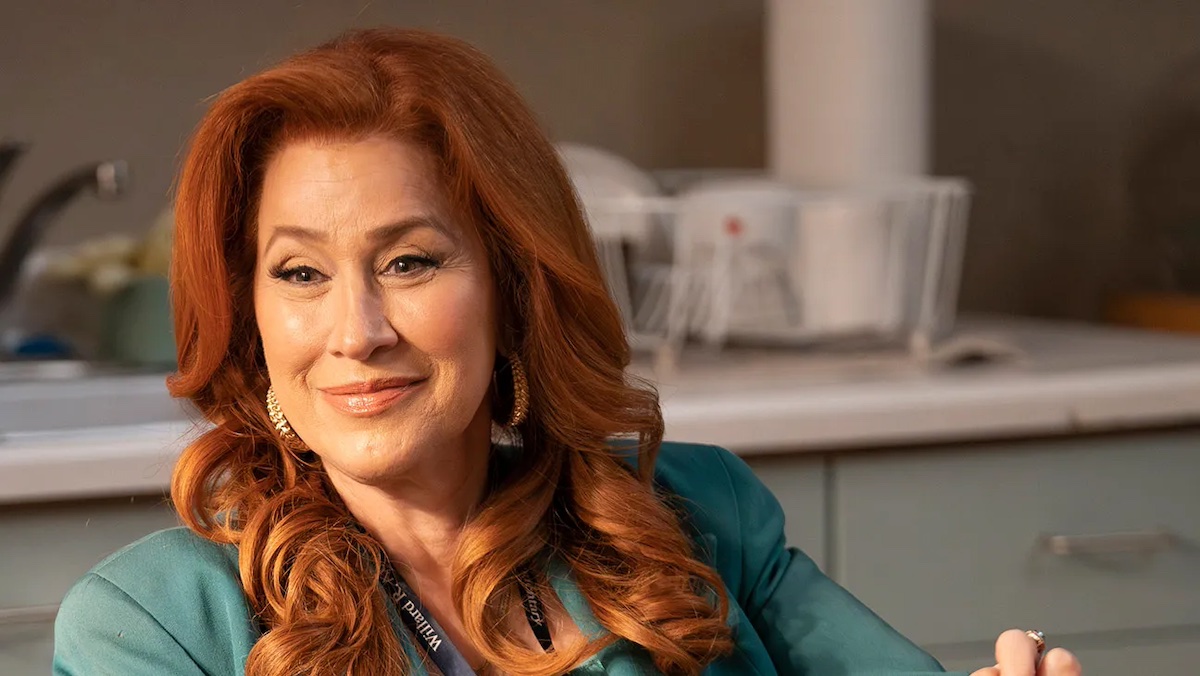
There are two types of people in this world: those who associate Lisa Ann Walter with Chessy from the 1998 remake of The Parent Trap, the most beloved pop culture housekeeper since Alice from The Brady Bunch, and those who associate her with Melissa Schemmenti, the tough yet tender second grade teacher who personifies the pazzo spirit of Italian Philadelphians on the hit ABC sitcom Abbott Elementary. (It’s also worth mentioning that she’s a Celebrity Jeopardy champion.)
Before those roles, Walter was a favorite on the stand-up scene in the late '80s and early '90s. On October 3 and 4, she brings her act to Batavia’s Comedy Vault for four shows that promise to please the Melissa Schemmenti contingent and might possibly scar Chessy lovers—and have everyone laughing.
We talked with Walter about her stand-up origins and what’s in store for Abbott Elementary in its upcoming fifth season, as well as revealing the secret to winning back the crowd at Showtime at the Apollo.
These days, most people probably know you as Melissa Schemmenti on Abbott Elementary or fondly remember Chessy from The Parent Trap, but you’ve been doing stand-up since the '80s.
I was an actor first, but I started doing stand-up right out of college, right after I had my first son, and that's what brought me to the party to develop sitcoms around my stage persona. So I've been...I started doing stand-up in '88 or '89, like a long, long time ago.
And it was only about six months into your standup career that you were a featured performer on Showtime at the Apollo.
There was a showcase back in those days. It was kind of the height of the comedy boom. I was working out in the New York area; those were my home clubs. I can't remember if I was a regular at the Comic Strip yet, but it was at Stand-Up New York. They had a showcase and they had people out to see comics.
I had a couple of bits that really were suited for Showtime at the Apollo. I grew up in the D.C. area, so I had a whole bit about our cheerleaders versus the white schools', and I had a bit about rap, and I had some bits that they thought would really work, and so we got the call. I can't remember if it was that night or the next night that they wanted me to come do the show.
And you know what was really funny? I remember I was driving home from doing gigs with the guy who was my husband at the time, who was also my manager. He became my manager kind of out of default. I mean, he was an actor when we met, but he just started doing it. We were driving home, and we knew we were going to do the showcase the next day. On the way from the city back to our house in Jersey, I was like, “Ah, I got a great idea.” And he was like, “What is it?” And I was like, “I got an idea for a bit about doing Double Dutch. I'm going to do it tomorrow.” And he was like, “You haven't done it on stage yet.” And I was like, “Yeah, but I can see it in my head. It's going to kill.” And I did it for the audition, and I know that was one of the bits that got me approved on the show. It was pretty wild.
There was a guy who went on before me as a featured stand-up act, and then they had Run-D.M.C., and then me. The guy who went on before me was from Atlanta. He was not New York, and he wore a suit. His whole act was “women be shopping.” It was not appreciated by that crowd. It was hosted by Sinbad at the time. The people in the audience stayed for the taping of, like, eight shows in a row. At the end of all those shows at 10 at night, they do all the amateur people in a row.
I was a featured act, but I was on towards the end of that long day. Those people were sitting in chairs, barely any bathroom breaks, no meals. It was hot; I remember it was August. They're in the mood to kill someone. So when they see something they don't like, they just start booing, even if it was a featured act. The guy with the suit—I was still in makeup, and I heard him saying, “Oh, just let me finish.” I thought, ‘Oh, they like him so much, they're not even letting him get through the setup.’ Well, that was not what was going on. They were booing him off the stage.
So when I went downstairs to do my bit after Run-D.M.C., Sinbad goes, “Well, they booed the black guy off, so you're next.” I went on stage and really attacked the mic. I was doing great. There was this old lady who used to sit right in front center named Mama. That was her nickname from everybody at the Apollo. She loved me. I was doing the bit about rap, and I just said, “Some of it's not realistic. Like the Tone Loc song, ‘Wild Thing’: ‘I was once like you, I like to do the wild thing too.’ If my Sicilian mother caught some guy shoving me in the middle of the living room, I don't think poetry would be a reaction.”
So it was clever, but all they heard was “not all rap is realistic.” They started booing and picking up. At that point, I—where are you? Is this a printed publication?
This is going to be online.
OK. At that point, it's live or die. I've been doing stand-up long enough to know that you have to win. You’ve got the mic, and you have the power, and you better be more powerful or they win. I wasn't going to let anybody win. The D.C. girl came out. I heard the boos kick up. I went, “Oh, yeah, well, the guys in the balcony like me because they're the ones that can see my tits.” They threw themselves out of their chairs laughing. They were like, ‘This little white housewife from New Jersey.’ I killed for the rest of the time up there. I slaughtered. Sinbad said to me, “That has never happened in the history of this show.” I saw him years later at the Montreal Comedy Festival. He said, “I've never seen it happen since.” That was a one-time deal, turning the crowd around.
I always admire a performer who is bold and quick on their feet. What does it take to achieve that level of comfort on stage?
I think there are two things. One is when you are authentically who you are. Your stage character might not be exactly who you are off stage, but you know that character on stage and how people experience it. I never really did great with a three-minute or six-minute set. I would always—if I had to audition for an artistic director like Lucien Hold at the Comic Strip, my ex-husband would be like, “We're going to produce an early show at 6pm. We'll fill the room. You get to keep all of the food and drink. We keep the door, the ticket price, and the artistic director watches a 20-minute set.” That's how I would pass at all the clubs.
At that time, there were only maybe 25–30 female comics in the country. There were rules for women. Clubs would say, “We don't book women who curse. We don't do blue comedy.” A lot of gay female comics were around because if you were straight, either the comics or the club owners would try to hit on you. If you didn't put out, they didn't want you back. There was a lot. It was a different time. You had to have real strength in who you were on stage and what your character was. I did. I knew who I was. I knew funny and I could hear funny in my head. I knew what people would like.
That particular bit, I saw the beginning, middle, and end, and I knew how it would work. It was a physical bit. I knew I could sell it. It's truly just being willing to show people who you are. That's always the comedy I responded to. I liked Richard Pryor. I loved George Carlin. I wanted to see your dirt, the spleen of it. I didn't respond as much to technicians like Seinfeld. I respect and admire craftsmanship, but for me, it was more about revealing truth.
What should fans who know you from The Parent Trap and Abbott Elementary expect when they come to see your act?
I didn’t do it for an entire marriage—my second marriage. I had a husband who did not like me to do stand-up for our entire seven-year relationship. I didn't do anything because he thought it wasn't feminine. After we broke up, I did tons of stand-up. Stand-up is like funny complaining. You can take life's pain and make it funny for yourself and the audience. That shared experience brings us together. It's healing for me.
I was worried people would get excited to see Chessy from The Parent Trap and hear jokes about babies, relationships, sex, and that it might be jarring. I used to say sometimes in the middle of the set, “How many childhoods have I ruined tonight?” That concerned me they wouldn't make the leap into who Lisa Ann is. But since Melissa, I haven't had that problem. People still want to meet Chessy because they want a hug. I get it.
I’m surprised Quinta Brunson hasn’t written a storyline where Melissa does some stand-up.
She fits (the cast’s talents) into the characters here and there. Barbara (Sheryl Lee Ralph) sings in the church choir. She took music class at the end of last season. Melissa does bad impressions. She does a series of bad impressions, like Sly Stallone as De Niro. She does, I guess, a version of stand-up through impressions. I’m not an impressionist. I had to clarify to the writers. They think I do good impressions. I mimic Sheryl or other cast members. They think I do pretty good impressions. That’s their version of what Melissa would do.
(At the interviewer’s request, Walter proceeded to do a spot-on impression of Sheryl Lee Ralph's Barbara.)
Stand-up has an immediacy to it that allows for immediate audience reaction that acting for film or television simply doesn’t. How do you know that what you’re doing is working in those environments?
I went into acting because I loved watching people feel things. I loved making them laugh. That’s the most immediate version: stand-up. Acting, if it's a play, people respond but not directly. On Abbott, we the cast work for each other and the crew. When we know we made them break, they’re holding their breath. Sometimes we throw stuff in at the end just to make each other laugh. Watching the show, people miss jokes because they’re laughing. Acting brings nuance, moments of vulnerability, saying one thing and meaning another, the camera sees it. That’s what I love about acting versus stand-up.
As you mentioned before, Melissa Schemmenti is a very different character from Chessy. What would you say is in the center of the Venn diagram of those two?
Chessy was a truth teller, even though she kept the secret for the twins. She was genuine and authentic. That bleeds into Melissa, though Melissa was more closed off to the rest of the characters. It was mostly just her and Barbara as a duo. Then there was Mr. Johnson a little bit on the periphery, because they had been together the longest. The young teachers were new. Bringing everybody in together happened gradually over the years, and it's still happening, which is wonderful. It's great for story and it's great for a character to always be discovering new stuff about the characters.
Speaking of The Parent Trap, you were in the Dancing With the Stars audience cheering on your former co-star Elaine Hendrix. Which of your Abbott co-stars do you think would do the best on DWTS?
Well, I mean, I don’t want to toot my own horn, but I did an entire ballroom dance movie called Shall We Dance? So I have ballroom training. That being said, I don’t know if I’m physically fit enough to take it on. I’m watching Elaine, who was a pro dancer when she came to L.A. She went to a performing arts high school in Atlanta and was a dancer. Then she came out to L.A., she was a pro dancer, and then she got hit by a car and her foot broke in several places. She has a titanium toe and she couldn’t dance any more professionally.
But it’s hard. It didn’t used to be like that at the beginning. At the beginning, when they were like, “We want people with no dance training,” they literally said, “You have too much dance training,” because all of those pros were my teachers. Tony Dovolani, Karina Smirnoff, Nick Kosovich, Charlotte Jorgensen—all the people in the first seasons as pros were my teachers on Shall We Dance? These are Blackpool champions.
So I was like, “Listen, I was not a pro, but I was a high-level amateur.” And then they sort of relaxed that. Now more than half of the contestants are professionally trained. One of those Mormon housewives has a Master’s in ballroom dance. These people are trained. Hilaria Baldwin has been training for years. So people are either like Jordan Chiles, who’s very athletic and has dance training because of the Olympics, or they are practically pro dancers. And then you have Andy Richter. There are two or three that—I don’t want to go on. I don’t want to go on the show and look bad.
I don’t think you’d be a cannon fodder contestant.
Nah, maybe not. But I will say that Quinta Brunson was a gymnast and did step—like how she had the step class on Abbott until Ava took it over. By the way, Janelle James does dance, so she’d be great too. But Quinta could do it. It’d be hard to find a pro partner for her because she’s so tiny. But I guess the gymnasts, when they go on the show, they’re little too.
Quinta teased that this year’s Christmas episode of Abbott Elementary is a “game changer.” How did you react when you learned what happens?
My jaw dropped. And everybody at the table, we all were like, ‘Wow.’ I will say that season five— we’ve never had this much not-the-usual in the classroom, in the school stuff. Everybody knows by now that we were in Philly and we shot during a Phillies game, a real game, and, by the way, a killer game. Holy moly. It was insane.
So we are out there doing a lot of different things, different from what people have come to expect from Abbott in the whole season so far. I said yesterday when we were on set, “This is the most Friday-ish feeling Tuesday I’ve ever experienced. And it is the most February-feeling September.” It feels like we’re at the end of the season, and we’re just getting started. We’re in the first third of shooting. So we’re doing so much that’s out there and different. I think people are going to really have fun.
Lisa Ann Walter appears at the Comedy Vault (18 E Wilson, Batavia) on Friday, October 3, at 7 and 9:30pm and Saturday, October 4, at 7 and 9:30 pm. Tickets ($42.99-87.99) are on sale now.
If you enjoyed this post, please consider supporting Third Coast Review’s arts and culture coverage by making a donation. Choose the amount that works best for you, and know how much we appreciate your support!
