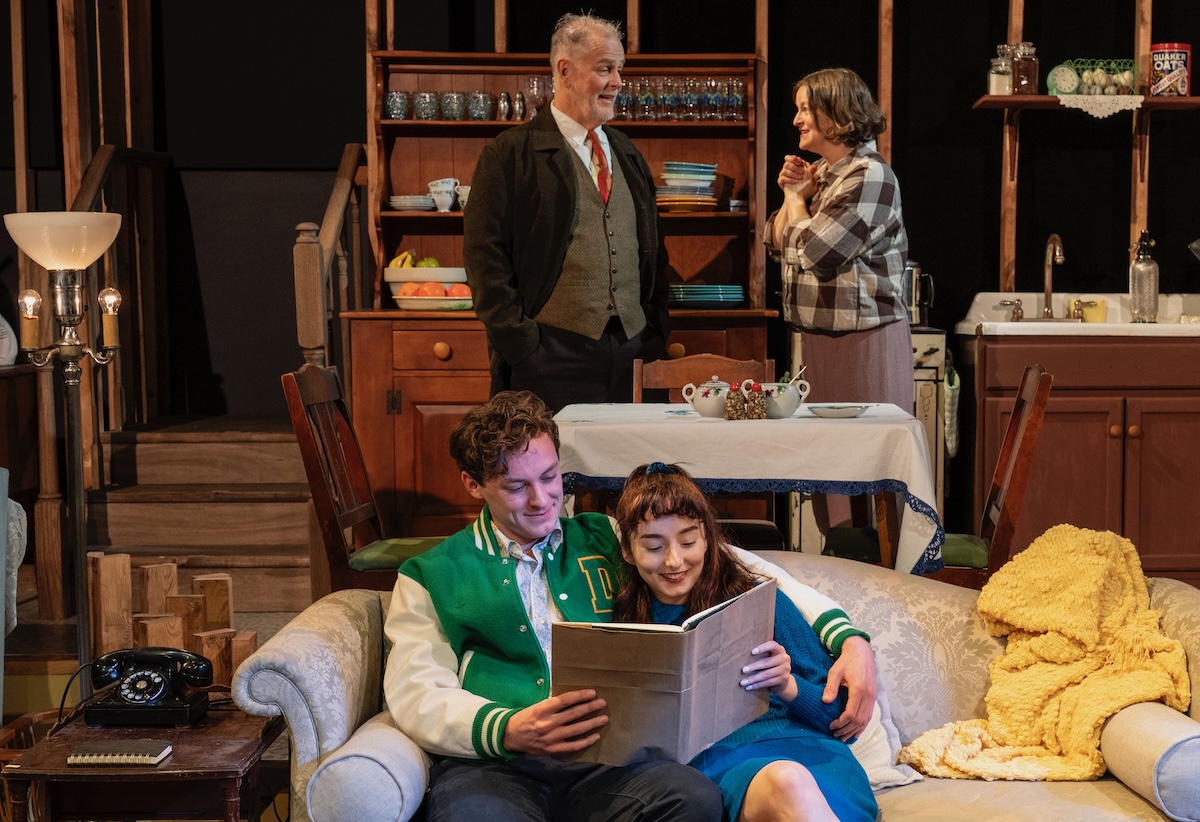

When "off-loop" Chicago theater hits on all cylinders, it packs an artistic punch that transcends limited budgets and reminds you why this city's small stages matter. Come Back, Little Sheba, currently running at the American Blues Theater, is one of those productions.
First produced in 1950, William Inge’s play sits in a particular corner of postwar American drama. While his contemporaries, Tennessee Williams and Arthur Miller, pushed toward Southern Gothic fever or public moral reckoning, Inge stayed close to the ground—Midwestern kitchens, small disappointments, and the kind of quiet despair that builds over years rather than erupting overnight. Sheba is one of his clearest studies of that world, and American Blues Theater’s new production, directed with precision and restraint by Elyse Dolan, understands exactly how and why the play works.
Lola and Doc Delany are a long‑married Midwestern couple whose lives have settled into a fragile routine. Doc is approaching his one‑year AA anniversary; Lola fills her life with chatter, errands, and memories of a youth that slipped away too fast. Their balance shifts when they take in Marie, a young college student, as a boarder. Her energy—and her flirtation with her classmate, the athletic Turk—stirs up regrets the Delanys have spent years trying to bury. Lola’s repeated calls for her missing dog, Little Sheba, thread through the play. The dog becomes a simple but piercing emblem of the life Lola once imagined for herself and can no longer reclaim.
At the center of this production stands Gwendolyn Whiteside, the theater's executive artistic director, who gives a performance of remarkable clarity as Lola. Shirley Booth’s original interpretation still casts a long shadow thanks to the 1952 movie version, but Whiteside never nods to it. She forges her own path, simply inhabiting Lola without any obvious actorly machinery. Her stellar performance has that rare quality critics once attributed to Laurette Taylor—technique so deeply absorbed it disappears. Whiteside’s Lola, hopeful and brittle in the same breath, is the production’s powerful emotional core.
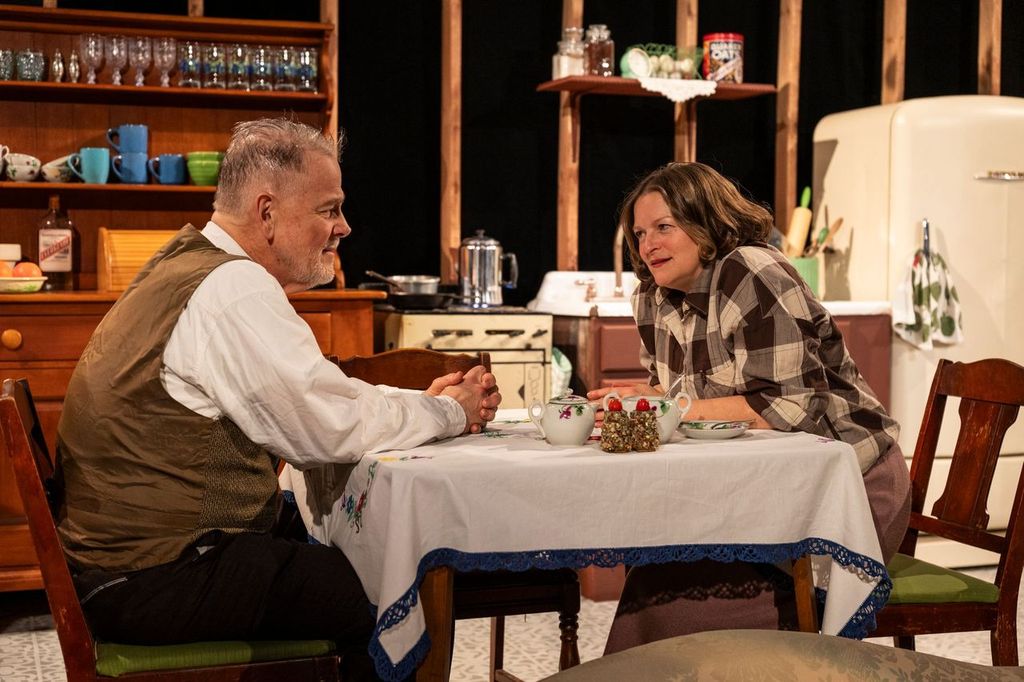
Philip Earl Johnson matches her with a sharply observed Doc. His Doc is a man who has learned to keep himself contained, which makes his eventual collapse and explosion all the more unsettling. Johnson understands that drunks often try (and fail) to appear sober, and the tension between control and unraveling gives the scene real danger. In the studio theater’s close quarters, the eruption lands hard.
Maya Lou Hlava and Ethan Surpan bring needed contrast as Marie and Turk. Hlava captures Marie’s mix of innocence and calculation without pushing either quality too far. Surpan’s Turk has the physical ease and swagger that unsettle Doc from the moment he appears. Together, they embody the youth and possibility the Delanys can no longer claim, and their presence sharpens the play’s emotional stakes.
The set, designed by Shayna Pate, turns the ABT studio into the Delany living room. Laundry piles spill into the audience’s path, and you literally move through Lola’s clutter to take your seat. It’s a clever idea, and it works: the space feels lived‑in, worn down, and slightly claustrophobic, exactly the environment the play requires.
A production this strong makes its small missteps more noticeable. The men’s costuming is ill-tailored, and Marie’s “party dress” later is also ill-fitting. These are small details, but they do distract a little from outstanding performances that deserve better support.
With that small quibble aside, the American Blues Theater has mounted a Sheba that honors Inge and brings his mid-20th-century drama to 2026 with fresh power. In particular, Whiteside’s Lola is a performance of rare delicacy and depth. This production reminds you why Come Back, Little Sheba mattered in 1950—and why, in the right hands, it still matters now.
Go see it.
Come Back, Little Sheba plays through March 22 at American Blues Theater, 5627 N. Lincoln Ave. The production runs a little over 90 minutes without an intermission. Tickets are available at www.americanbluestheater.com.
For more information on this and other productions, see theatreinchicago.com.
Support arts and culture journalism today. This work doesn't happen without your support. Contribute today and ensure we can continue to share the latest reviews, essays, and previews of the most anticipated arts and culture events across the city.
