
The National Hellenic Museum’s annual trial of a Greek legend returned triumphantly this year with The Trial of Odysseus, the hero of Homer’s Odyssey. Since the series was founded in 2013, some of the trial defendants have been well-known, like Socrates or Pericles, while the series also has featured Themistocles and Megacles.
This year’s trial, in which Odysseus is charged with murder in the first degree, was particularly dramatic because of the defendant’s fame in literature, film and visual arts.
The trial is an annual benefit for the museum and draws an audience of about 700. The event explores topics from ancient history with modern implications. The trial follows US legal procedure, featuring arguments by local litigators, a panel of four local judges, and a jury of community and media representatives. Actors perform as the defendant and the witness. The event is unscripted; each lawyer, judge, defendant and witness research and prepare their own remarks.
At the end of the trial, the jury decides its verdict and the judges announce theirs. The audience, representing the citizens of Athens, votes by dropping blue or white chips in bags passed around the auditorium—blue representing guilty and white not guilty.

First a bit of background. Odysseus’ actions in committing murder—killing the “suitors” or “usurpers” who sought to marry his supposed widow Penelope and take over the kingdom of Ithaca—take place after the military leader returns from his 20-year absence. He spends 10 years fighting and winning the Trojan War and then takes another 10 years to reach home because of his encounters with the Cyclops, the Sirens and the enchantress Circe, among others. He arrives home, exhausted, and, with the help of the goddess Athena, disguises himself as an elderly beggar, disclosing his identity only to his son Telemachus, who tells him that the “suitors” have lived in Odysseus’ palace for three years, drinking his wine and eating his livestock.
Meanwhile the loyal Penelope puts off the marriage decision they demand, because she does not want to believe she is a widow. She proposes a contest among the suitors to see who can string Odysseus’ rigid bow and shoot arrows through 12 axe shafts. All the suitors fail and at that moment, Odysseus steps forward, succeeds at Penelope’s challenge, and reveals himself as the king. Odysseus and Telemachus then murder all the suitors.
The trial begins with a video explaining the background for Odysseus’s alleged crime. Then the four judges take their seats on the bench—presiding judge Georgia N. Alexakis, Sara L. Ellis, Jeffrey G. Chrones, and Anthony C. Kyriakopoulos.
Chicago legal professionals present the cases for and against Odysseus. Representing the defense of Odysseus are Patrick M. Collins and Tinos Diamantatos, both of King & Spalding LLP. Representing the prosecution are Antonio Romanucci and Daisy Ayllón, both of Romanucci & Blandin LLC. The lawyers obviously enjoy their ability to perform in a more theatrical form than a typical trial allows them; they often add references to the current political environment.

Odysseus is played by Christos Vasilopoulos, a television actor in Greece and the US; he holds a black belt in tae kwon do and a brown belt in Brazilian jiu-jitsu. Phimeus, poet and longtime friend of Odysseus, testifies against him; Phimeus is played by Leonardo Sfondouris, known for his roles in Greek television. In Chicago, he is director of the Greek theater group, Ektos Edras.
Romanucci and Collins make opening statements for the prosecution and the defense. Romanucci focuses on the legal rationales for a guilty decision, noting that Odysseus is guilty of premeditated murder and that he does not have sovereign immunity because he presented himself as a beggar. Collins explains why the murders of the hundred-plus suitors (each armed with his own sword) were not premeditated. The moment that Odysseus wins the contest and reveals himself as king, “It’s game over,” Collins says. “It’s now 100 to 2.” (The prosecution’s arguments, he says, are “fake news.”) He also tries to build sympathy for his client and emphasize his military exploits as well as his strategy in devising the “Trojan horse” that won the war for the Greeks.
The poet Primeus, who has been entertaining the “suitors,” makes a statement to the court, explaining why he believes Odysseus to be guilty. The king did spare his old friend in the process, he admits later when questioned by the defense.
Odysseus then is allowed to step to the podium and make his own statement describing why it took him so long to reach home and why he was not guilty of premeditated murder. Romanucci questions him and then Diamantatos questions his client.
Closing statements are made by the opposing lawyers. Romanucci uses props—a lady of liberty statue and a small replica of Odysseus’ giant bow. Diamantatos points out that Odysseus had the right of self-defense, and defense of his family and home. He also says the prosecution should get in touch with Homer: Their characterization of The Odyssey should be retitled Diary of a Wimpy Kid.
Ayllón makes the final points for the prosecution. In conclusion she strides across the stage and places a copy of Homer’s The Odyssey on the defense table. “Read it. It’s all there,” she says, “in chapter 22.” (That chapter is titled “Slaughter in the Hall” in the Robert Fagles translation.)
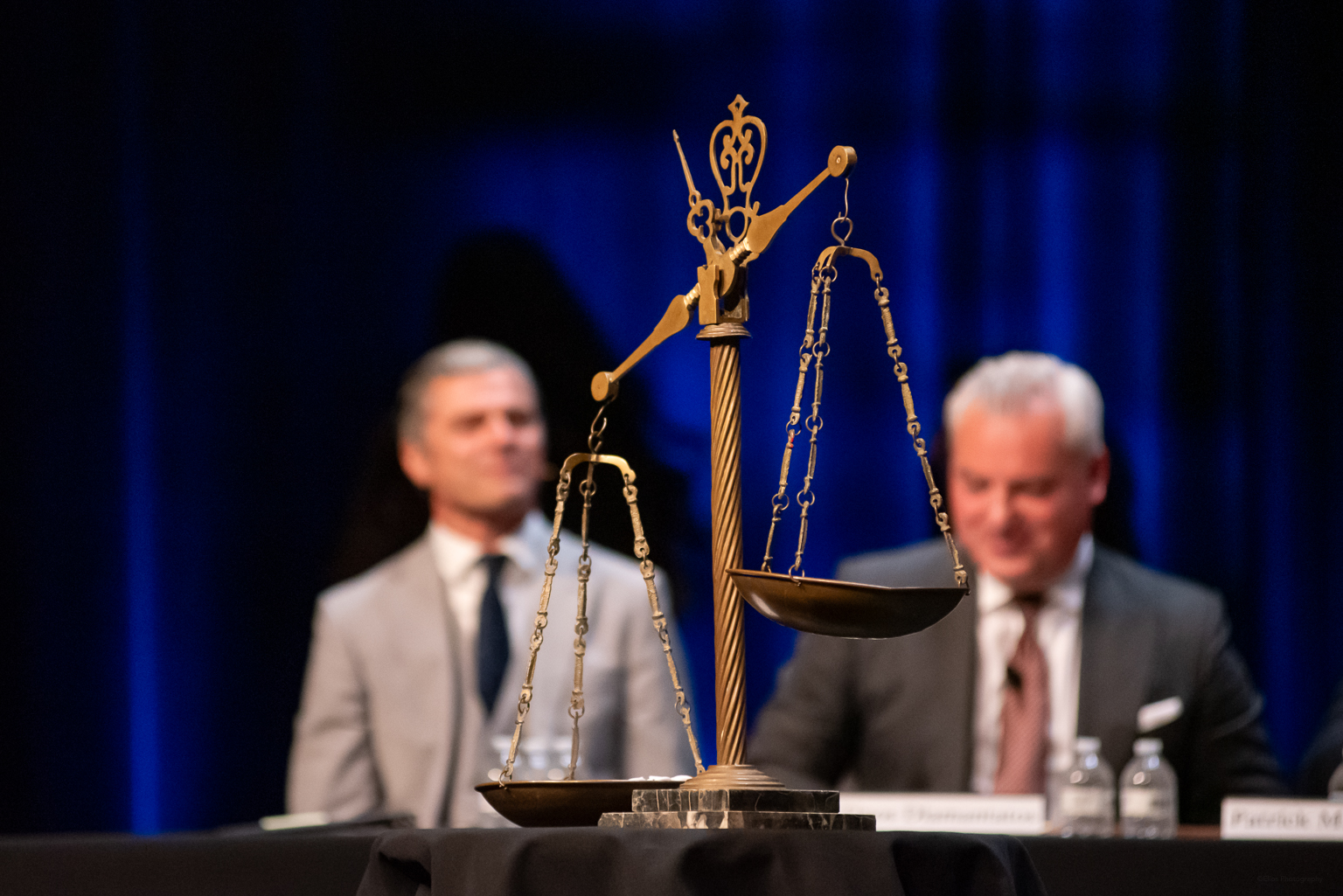
Now the judge instructs the jury and the jury departs to consider their vote. The citizens of Athens (the audience) drop their white or blue chips (for not guilty or guilty) into blue and white bags passed among them. It was hard for me to vote against my hero Odysseus but my plus-one and I voted not guilty based on his lack of premeditation and his right to defend home and family. Although some jury members and one judge voted guilty, the vote found Odysseus not guilty. That vote was dramatized when the heavy bag of white chips was poured on to the scale; the much smaller pouch of blue chips did not tip the scale.
If you’re intrigued by this trial story, watch the television schedule; the video will be broadcast by PBS later this year.
Also consider watching The Return, a 2024 film starring Ralph Fiennes as Odysseus and Juliet Binoche as Penelope, directed by Uberto Pasolini. The Return tells this portion of the Odyssey—Odysseus’s return to Ithaca and the drama that follows. See it on Prime Video or AppleTV for $4, plus other streaming services.
Peter Bradshaw’s review in the Guardian notes: “Ralph Fiennes is Odysseus, enigmatically washed ashore semi-conscious in a way we associate in fact with late Shakespeare rather than Homer; he is reluctant to reveal himself, maybe through shame at having not returned before, at returning now in chaotic poverty and isolation and overwhelmed with his secret knowledge that the glories of war are a shameful delusion.”
The National Hellenic Museum will present another trial next year; watch for the date.
Support arts and culture journalism today. This work doesn't happen without your support. Contribute today and ensure we can continue to share the latest reviews, essays, and previews of the most anticipated arts and culture events across the city.
