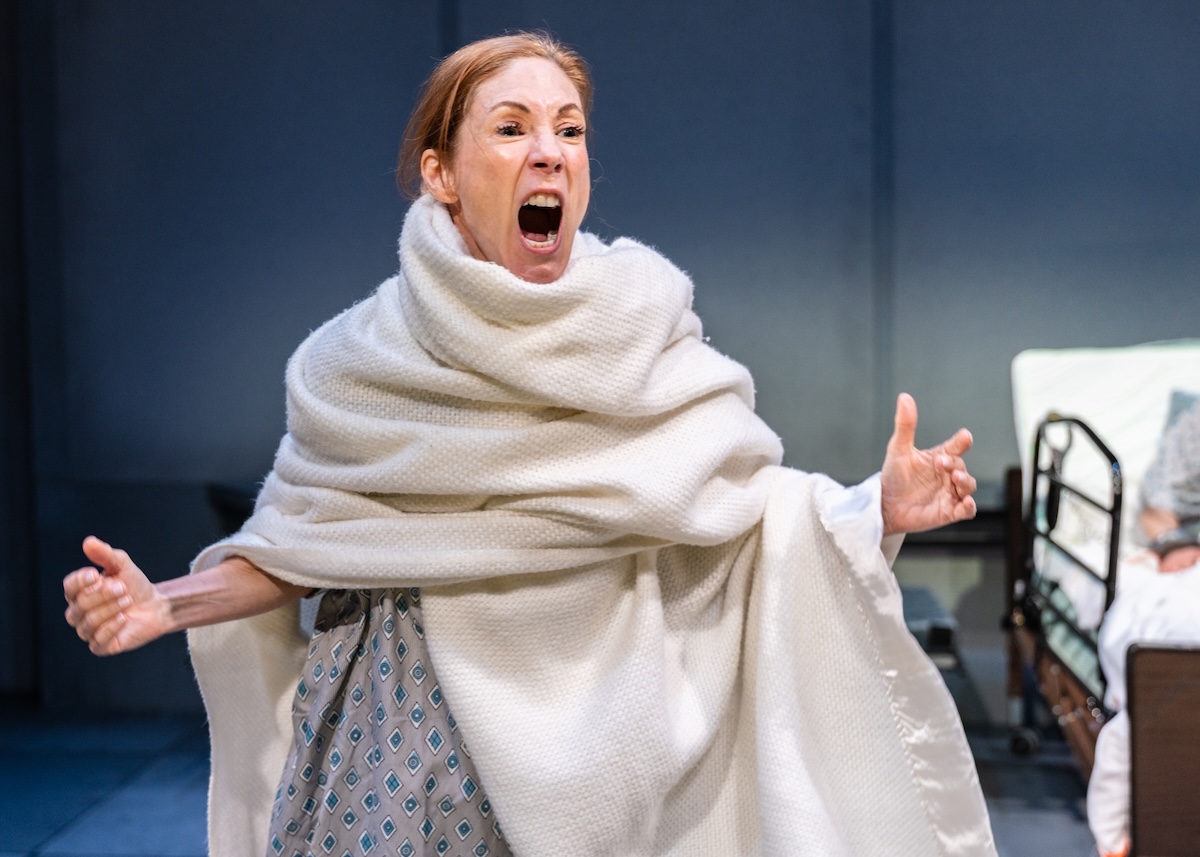

The Trojan Women is a play about yesterday that speaks to today. It’s a powerful story about how women suffer in wartime, a commentary on the costs of war and its impact on women and children. The Trojan Women is the inaugural production by Eos Theatre Company, newly founded by four women theatermakers. The contemporary script by British playwright Caroline Bird is based on Euripides’ version. Rachel Sledd directs, designs costumes, and also plays Athena, the goddess of war, in the play’s video prologue.
Bird’s script is set in the mother and baby unit of a prison in Troy, after the war with the Greeks, led by Odysseus. The Greeks are victorious over Troy’s army led by Hector, son of Queen Hecuba and King Priam. The performance is somber but sometimes comic and insightful about the feminine condition.
The play opens with a video on a large screen, with a background of battle scenes. Poseidon, god of the sea (Brian Weddington), describes a particularly gory incident that happened to a young mother, and then paints a broader scene. “Most things are on fire, and the things that are not are clothed in thick shadow. The civilians are dead. Wish you were here. Everyone who doesn't matter is dead and the ones left alive will lose everything worth living for. Round up the royal whores….Oh, and the king is dead.” Athena joins him and tells Poseidon, “I want the Greeks drowned on their way home.”

Hecuba, the former queen (Ashway Lawver), is a prisoner in the mother and baby unit, dressed in a shapeless hospital gown and socks. Lawver is proud and regal as the queen, even without her royal adornments. She mourns her fate, “A queen without a city. A mother without children. Troilus, Hector, Paris, Polites, Deiphobus, Hipponous, Antiphus, seven heroic sons, all dead, Cassandra in the madhouse …. The air conditioning is too much.”
The only other patient now is Chorus (Morgan Lavenstein), a pregnant young woman whose husband was killed by the Greeks. She’s about to give birth, handcuffed to her hospital bed.
The representative of the Greek victors is Talthybius (Ben Page), the Greek herald and hospital orderly, who brings the prisoner/patients their food and medications. Page is imposing but human, armed with machine gun, clipboard, a pager and mobile phone. He brings the women news about their fates. All the Trojan women will become slaves or concubines to Greek victors. He informs Hecuba, no longer a queen, that she will belong to Odysseus, the leader of the Greeks. (Of course, no one knows that Odysseus won’t be home for 10 years because of the trials and temptations he meets on his voyage from Troy to Ithaca.)

Hecuba is childlike as she sits on the floor wrapped in a blanket, eating the sandwiches and drinking the mini-bottles of wine provided by Talthybius. She and Chorus develop a relationship, after Hecuba gets over her queenly expectations.
Talthybius snatches away their blankets, even the duvet that Chorus is wrapped in. He tells them, “It's not to humiliate you or make you cold. These can easily be torn and twisted into nooses. They’re not … despair proof.”
Talthybius brings in Cassandra (Liliana Mastroianni) to see her mom. Cassandra dances, sings and sometimes talks nonsense. She knows that her fate is to become the concubine to Agamemnon, the Greek leader. Cassandra has gone mad because she speaks true prophecy and no one believes a word.
Hecuba’s daughter-in-law Andromache (Jazmine Mazique) arrives with her baby son; she’s the widow of Hector, who died leading the Trojans in battle. Hecuba is thrilled to be the grandma to the new infant, but mourns their fate. Andromache will be given to Achilles’ son—and her infant son will not survive because he might grow up to become a warrior like his father.
As Hecuba says in Seneca’s version of this play: “Nothing is safe or sure but ruin itself.”
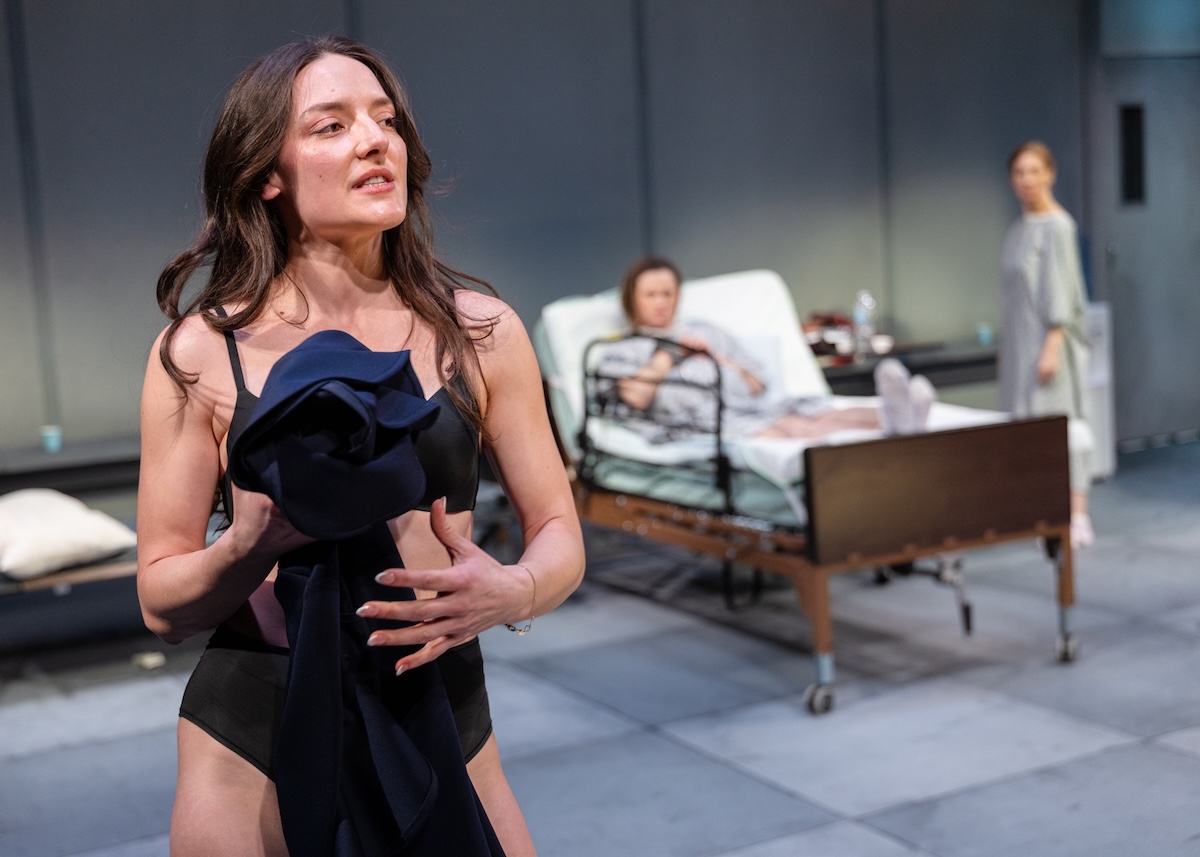
During the second half of the play, we meet Helen of Troy (Morgan Burkey); she caused the Trojan War by leaving her husband, the Spartan king Menelaus (Marcus Castillo), for Paris, prince of Troy. She arrives in a robe, strips to her undies, and later dons a slinky dress and stilettos. When Menelaus arrives, he and Helen share expressions of hate and lust.
Director Sledd moves this gripping script along briskly; not a moment goes by without action. The cast is excellent with exceptional performances by Lawver as Hecuba, Lavenstein as Chorus and Page as Talthybius, all of whom are on stage throughout the play.
Shayna Patel is set designer; Garrett Bell handles lighting design. Sound design is by Mason Absher. Videography is by Kevin Reodica. Michael Lesko is stage manager.
Eos Theatre Company was founded in 2025 by Sledd, Lawver, Lavenstein and Burkey with the goal of amplifying female voices and narratives. They first staged The Trojan Women for a short run in February 2025. The company is named for Eos, the Greek goddess of the dawn, who “pulls back the curtain of the night to usher in the light of the sun.”
The Trojan Women by Eos Theatre Company continues at the Bramble Arts Loft, 5545 N. Clark St., through April 19. Running time is about 95 minutes with no intermission. Tickets and more information available here.
For more information on this and other productions, see theatreinchicago.com.
Support arts and culture journalism today. This work doesn't happen without your support. Contribute today and ensure we can continue to share the latest reviews, essays, and previews of the most anticipated arts and culture events across the city.
