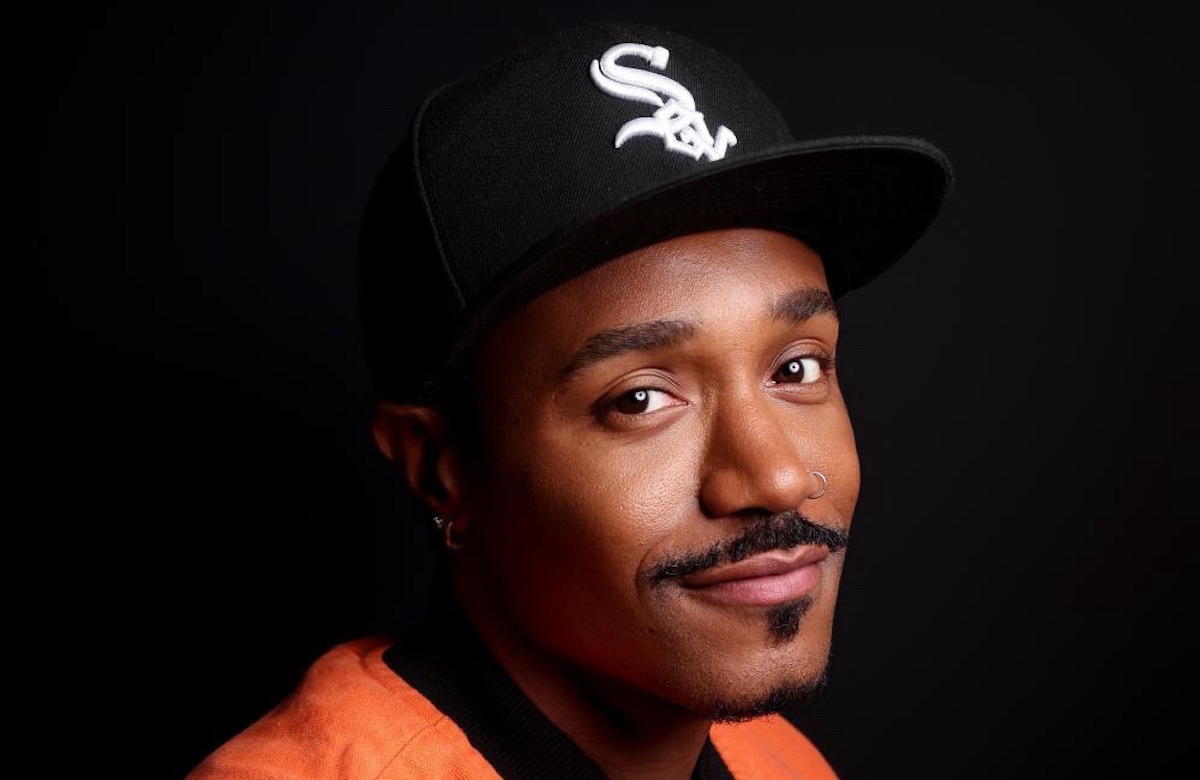
Improv, standup, sketch, TV, film—however you like to laugh, Dewayne Perkins does it, and he does it brilliantly. One of comedy’s finest rising voices, the Chicago native and Brooklyn Nine-Nine scribe is bringing his new one-man show, How Being Black And Gay Made Me Better Than You! to the Den Theatre for a one-night engagement on April 30. We caught up with the magnificent multi-hyphenate for a conversation about what makes Chicago such a great city for comedy, working with Catherine O’Hara on The Studio, and getting starstruck by Power Rangers icons.
You were born and raised in Chicago and found your comedic footing here. What does it mean to return to the city and perform at the Den?
It means everything. I think that Chicago is such a big part of my artistic story that it always feels like a place that I have to stop in. It just feels like a childhood friend that I know will always receive me well. So it's like the best place to test stuff out, and because that's where I started, it's always kind of a nice experience to have the memories from where I started and then where I am now. It was always very cathartic.
You were involved in the comedy scene for a long time here. What is it about the Chicago comedy scene that makes it so special? What do you find here that you don't find anywhere else?
I think that there is a certain passion that is created through motivation that's not financial. And I think that creates a special kind of artist. The coasts are known for having industry, and Chicago is known for creating art. And people create art with the fervor of following dreams, whereas the coasts feel very much job-oriented. Chicago feels like a place that is so steeped in emotion that's attached to art, because art has power to express how you're feeling, to lift you out of the situation that you're in and put you somewhere else.
And so I think that there is just a more fantastical approach to art that makes the art more artful and creates a better artist. I've lived in New York. I lived in LA. And I definitely think that my time in Chicago prepared me significantly to navigate those markets in a way that allows me to retain who I am as an artist. I just knew before I left Chicago that that was the whole training process. It's like knowing who I was and knowing what I bring to these other places versus going to these places and thinking I have to change myself to fit whatever they're looking for.
Let's talk about the show that's coming up at the Den. It's called How Being Black and Gay Made Me Better Than You!
Yeah, it's very straightforward. Very on the nose.
And no arguments here. I'm curious how your identity has shaped your comedic voice.
I think that they're the whole thing for the most part. Living in an identity that is so defined by outside voices, and growing and evolving in a way to know how to delineate what feels inherently me and what feels like what society has told me I should be. Navigating that is what allowed me to find my voice and take what felt at one point like oppression into what feels currently like a superpower, and knowing exactly how to utilize who I am to push my own agenda.
The struggles of existing at the intersection of Black and queer fortified me in a way that allows me to have the confidence to confidently say I'm better than everybody. And even if it's not true, who's going to tell me it's not? I made it up. And so ultimately that's where it led to me being the best person to ever exist.
Do you ever feel like there's any pressure on you to behave in a certain way or represent something bigger than comedy because of it?
Yes, I feel like that's always been a thing. But I think I've gotten to a place where I know what feels organic and what feels more of me, and that allows me to kind of step into that role, because that's what I would do anyway. I don't feel any pressure to necessarily speak to my identity. I just do it because it's the identity that I have.
In my comedy, I'm very much more interested in dissecting myself and my own life versus the world, because I can't control the world. I don't know what they're doing out there. But I know who I am and I know what my life has been. I've done a lot of work personally to become the person that I am, so it makes sense not only to be able to benefit from that work as a person, but also use that to benefit my art. Ultimately, I'm just going to do what I want. So even if I do feel that pressure, if it doesn't feel like something I want to do, I simply want to do it.
You’ve always been a very unapologetic writer and performer since making your Second City debut over a decade ago. I’m curious what shifts you’ve noticed in terms of how audiences interpret your comedy over the years.
Honestly, I think it's been pretty consistent from when I first started, and I think that is what has allowed me to kind of move with a sense of confidence. Because I've noticed patterns very quickly. I'm a very data-oriented person. There's no point in me trying to change. I’ll just be unapologetically me. The audience has an opinion on the world because they live in the world. The audience has no opinion on me. You can't speak to me about me because I have the most information. So I am the smartest person in the room in reference to what I'm talking about.
So I'm setting myself up for success every time because it's my life. There's nothing that the audience can—they can bring their points of views and digest what I'm saying, but it all very much is being an observer to what I'm presenting, which is, ‘Oh, this is the life that I've led. Here's what I've learned. Here's what these experiences taught me. And this is who I am now.’ So my comedy has evolved because I've evolved as a person, but the methods are pretty much the same. This is me.
You were on the writing staff of shows like Brooklyn Nine-Nine and the Saved by the Bell reboot. What do you find is the biggest difference in writing a project like that versus coming up with your own comedy?
I would compare it to, one is like playing God, then one is like being a disciple to God. Because making your own stuff is, you just kind of having the ability to just make whatever's in your head in a very clear way. Like, this is what I want. I think that's the biggest difference, figuring out how to amplify that, whereas writing for other people is knowing what's their mission and then knowing how you can amplify that. And so they both kind of exist in a similar place of knowing who you are and knowing what you can bring, but one of them is in service of someone and one of them is in service of yourself. They're similar in execution, but different in terms of what you're trying to accomplish.
How did you manage to still bring in your own unique, unapologetic voice to those projects?
I just recognized, even within the interview process, what's the point of me being here? I wasn't brought in to mirror other people, because then you could have just hired somebody else. The point of you hiring me is to bring myself to this so that you have a point of view based on my lived experience that can then allow you to see this in a different way, which may bring about different storylines, may bring about different jokes, because I have different reference points.
And so it all kind of comes back to knowing who I am, what I can do, and knowing that I was hired for exactly that. And that's very easy to do because it's just me at my neutral, like knowing that who I am at my stasis is what they're hiring.
So there's just not really much to do but exist how I would in that space. And I've already done the work to know that who I am generally is great. So if you're hiring me to just be great in this space, I don't have to do anything but show up.
Do you happen to remember the first joke that you told, whether it was on stage or just somewhere in real life, that made you realize, ‘Hey, I found my voice, this is who I am’?
There's two moments that come to mind. One of them was the very first time I did stand-up, which I just remember being very nervous because I went to an open mic and it was not going very well for a lot of people. So the audience was just not enjoying it.
And then I got on stage and I had on a very long, humongous scarf that was kind of ridiculous. That was just like the scarf I was wearing at the time, and I made a joke about it and the audience laughed. And I was like, ‘This ain't even a joke that I wrote.’ I just (made) a comment. And I said, “Oh, alright, I'm funny.” Even though this (was) a new medium, I'd trained in improv, I'd done sketch, I am funny generally. Just because I'm doing it in this way doesn't mean suddenly I'm going to forget how to be funny. And then that nervousness kind of went away immediately.
And then when I first started doing sketch, I was doing solo sketch and I had a scene where I was playing like a very urban DJ, but I would only play songs from musical theater. And it was just like the juxtaposition of that, which felt like very much of me, for the audience to receive it the way that it was. I was like, ‘Oh, right, this is who I am and what inspires my comedy works. This is simply funny and I don't have to find the joke. I am the joke.’ I'm just kind of a jester. That's just the role that I've assumed in life. I love comedy naturally. I see things in a very comedic rhythm. And I just was like, ‘Oh, this is it. I'm just gonna keep doing this. I love this.’
Speaking of your sketches, there's The Blackening, which evolved from a Second City sketch to a Comedy Central sketch to a feature-length movie. I'm curious if you see yourself revisiting that in the future.
That's the hope. We're currently working on a sequel now. And so hopefully that pans out. You never know with Hollywood. But yeah, we've been working on that. I think it's fantastic. I'm obsessed. And my whole goal for The Blackening was a franchise from the beginning. I already know in my head at least three. I know the trilogy. And so I'm manifesting it to go exactly as I want. And so far, so good.
You also have a recurring role on The Studio. I was curious, with your experience in the industry, how accurate do you feel the show is in portraying the entertainment industry?
Oh, it's pretty accurate. It's very funny to be able to play a person on the other side, knowing that I've been in meetings with executives and they have played out very similarly. And since I've been on this show, I've had conversations with executives who are like, “Hey, so is that about us?” And I'm like, “Maybe. If the shoe fits, wear it.”
So yeah, I think it's a perfect version of what I feel Hollywood is. And it is very comedic in that sense, where you are in some of these meetings, you're like, ‘This feels like a TV show. This is so unhinged.’ But that's just kind of how this business works.
And of course doing that show you got a chance to work with the amazing Catherine O'Hara. You described her in a recent interview as very down to earth and called her a great blueprint for what people in the industry should strive to be like in treating others. What other lessons will you take from working with her?
One big lesson is, I really see comedy in kind of a scientific kind of way. There are some anthropological things. There's some psychological things. And then there's just kind of physical things, the rhythm of things, the kind of beats of comedy. And one thing that she did very well that I was studying is using language, like the way that you stress certain syllables, the way that you give space to certain dialogue. There are jokes that are funny, but then there are ways that you can say them that amplify the funny. And I think that she was a pro at that.
One of the executive producers recently told me that when they write lines, they kind of have an idea of how I would say it. And then they told me whenever we do takes that I always kind of have a different way. They're like, “We never thought you would say it that way.” Sometimes you gotta switch up the flow, switch up the rhythm.
I feel like, rewatching Schitt's Creek, that was her. I was like, “Ah, why would you say it that way?” Insane, but so funny. So kind of having that freedom to just play and know that it may be a big choice, but it also might be the right choice.
The “fold the cheese” scene on Schitt’s Creek is a classic example. In the hands of a lesser talent, that could have been a nothing moment, but she made it iconic.
Yeah, a legend.
Who would be the Mount Rushmore of other comedic legends that you would just absolutely love to work with?
The top of my list is Regina Hall. I think she's probably my favorite actress. And it's very funny when people ask me about like comedians and I'm like, Regina Hall. I think comedic acting is such a skill set, and hers, I just think she just has a toolbox that is just full of great things. And I think the way she oscillates from drama to comedy is really something to admire. So she's at the top of my list.
Seth Rogen was, but now I've already done it. And I think similarly he's like a very good blueprint, career-wise, to where I've been trying to kind of follow in his footsteps in terms of the range in which he's allowed to kind of exist in, from starting (with) stoner comedies to doing more prestige stuff to even the Teenage Mutant Ninja Turtles movie, which I thought was great. So he's one of them.
Wanda Sykes was one, but I'm so happy I got to work with her on The Upshaws. I think she is an icon as well and has really opened doors for queer Black people. Fantastic.
You're obviously a very confident and self-aware person. Do you ever get starstruck when you meet people like that?
I do. And it's so strange who I get starstruck by because it's less like adult me and more like young me, like the inner child of me being like, ‘Oh, that is a person that affected me as a child that has significantly made me want to do a thing.’ They're people that I really admire their work. And I'm like, ‘Oh, that's a person that does really good work. Oh, I love them.’
One of the things that stand out to me—I was working on Brooklyn Nine-Nine at the time—Christina Vidal, who played Taina in the Nickelodeon show Taina, she walked by me and I literally went like this (eyes bugging). I didn't realize I would be starstruck until I was. And I talked to her. She was so nice. We took a picture. But it's moments like that to where I saw the actors that play Bulk and Skull from Power Rangers. And I was like, it's morphin’ time right here. Oh my gosh. There are moments like that where I just have an emotional response that's unexpected. That's when I feel the most starstruck. But usually I'm like pretty chill because I recognize most people are just normal, just doing a job.
Aside from the appearance at the Den, The Studio, and hopefully future installments of The Blackening, what are some of the other upcoming projects that we should be looking out for?
I'm shooting a short film in Chicago as well while I'm there. I'm getting into directing. As I continue to grow as an artist, I'm very interested in creating full visions from beginning to end. I think I've been an integral part in creation, but I want to be able to be able to dictate what that vision is. Directing is like the next organic step. Look out for Dewayne the director.
What is your advice for Chicago comics who are trying to build their careers?
Someone recently asked me for advice and I gave them advice, but it was with the caveat of, I can only give the advice that I've experienced. One of them is being a multi-hyphenate. That opened up so many opportunities for me because it gave me, firstly, more skills. I just had a lot of skills that made me more of an asset to people when I was hired. It also gave me the ability to pivot when things were not going the way that I wanted and knowing that, ‘Ok, well, if I'm not getting an acting gig right now maybe I'll go do writing. Writing will put me in the room with this person and they’ll give me an acting job.’
So there's this big puzzle that I feel like being a multi-hyphenate gave me so much more options than if I was just an actor, if I was just a writer. I think that is very important, to not isolate yourself to one lane that then dictates your opportunities by other people, and create your own stuff. I think that was imperative to getting me to where I am now. I would not be where I am now if I didn't create the Blackening sketch without knowing where it was going to go. It wasn't me being like, ‘I'm writing this sketch because I want it to be a movie.’ It was, ‘I'm writing this sketch because I need to create so I have something to showcase.’ How are people going to know me if they don't know what I can do?
And then lastly I would say don't try to be like other people, because at best you'll be a great number two. Knowing who you are and trying to be the best version of that, you're setting yourself up for greater success, because no one else can be a better version of you.
Dewayne Perkins's How Being Black And Gay Made Me Better Than You! will be performed at the Den Theatre (1331 N Milwaukee Ave) on Thursday, April 30, at 7:30pm. Tickets (starting at $28) are on sale now.
xSupport arts and culture journalism today. This work doesn't happen without your support. Contribute today and ensure we can continue to share the latest reviews, essays, and previews of the most anticipated arts and culture events across the city.
