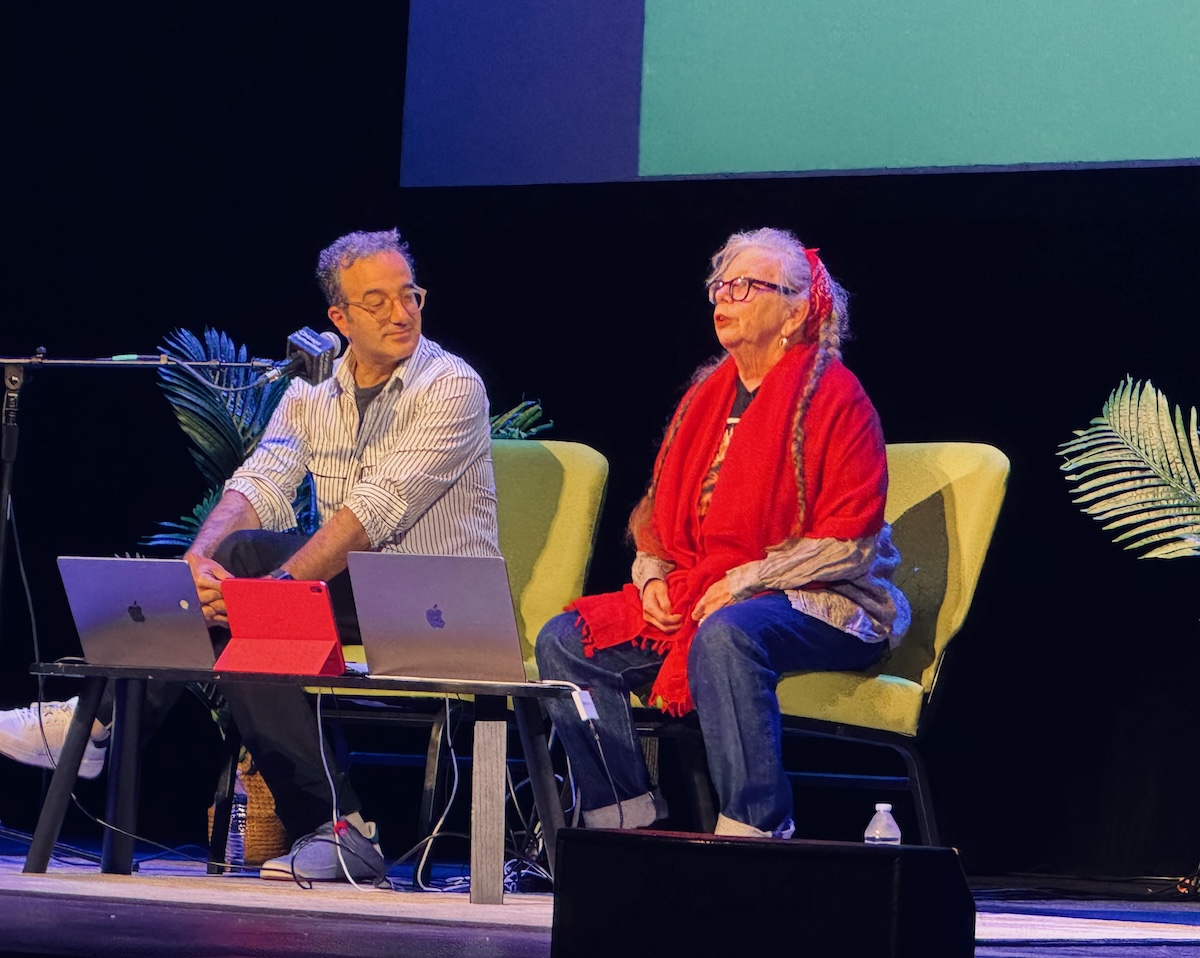
I took a sentimental journey back to the '80s recently when.Lynda Barry was featured at the Chicago Humanities Festival in a conversation with journalist and Radiolab founder Jad Abumrad. Barry is an artist and instructor at the University of Wisconsin, Madison. Abumrad and Barry had a fascinating conversation at the Athenaeum Center about how ideas are formed and the potential for artistry to express them, regardless of artistic education or background. The event was titled "An Unnameable Energy: Why Art Matters Now."
For 30 years, Barry created comics for publications like the Chicago Reader and the Village Voice. She was also the author of the play The Good Times Are Killing Me staged in 1989 at Live Bait Theater. Abumrad founded Radiolab in 2003 and was the host with ABC science reporter Robert Krulwich. The show became known as a source for in-depth reporting on cutting-edge subjects.
In mu weekly perusal of the Reader, I would read articles and the unbelievable personals. The features weren't exactly piquing my curiosity, so I turned to the cartoons, which were unlike anything I'd read in the dailies. Phoebe and the Pigeon People and Humerus Cartoons were full of irony and looked like people I saw every day in Rogers Park. Then I came across Ernie Pook's Comeek by Lynda Barry and felt a connection to Marlys Mullen and her oddball reveries, like Poodle With a Mohawk. Her drawing style was unlike any of the cartoons I read as a child. Barry's drawings were frenetic and organic. Barry has worked with children and adults. She noted that children's minds are less crowded with the need for perfection when drawing a cartoon.
Abumrad did a series of podcasts called Dolly Parton's America, and then a fascinating series on Fela Anikulapo Kuti, the Nigerian musician and political activist. Abumrad claimed that Fela's story had been forgotten and almost erased, but I disagreed with that statement. The Broadway show Fela! was nominated for 11 Tony awards in 2009 and went on a nationwide tour, with a stop in Chicago. Afrobeat music remains quite popular, and Fela is still revered as a musician with spiritual and political power, even after his death in 1997. What was the source of Fela's musical hold over people?
How does Lynda Barry continue to show people that they have creativity? Barry said that her students had to put aside the notion that they could not draw, when in fact, kids drew the best cartoons.
I felt that Abumrad was over-intellectualizing the creative process while Barry's approach was more holistic and quirky. Somewhere along the way, people lose their sense of whimsy, and while art can combine with science, looking for logic or perfection can squelch creativity. Barry said, "Comics rely on the smallest little lines." If you look at Ernie Pook's Comeek, there seem to be hundreds of little lines that enhance emotions, absurdities, and life. Barry finds leeway in spontaneous art. Drawings are living things to her.
One of the things Abumrad and Barry have in common is mixed foreign parentage and a sense of being the "other" who never quite fits into the larger whole, which is often a homogenized, cookie-cutter way of life. Abumrad is Lebanese American and grew up in Tennessee in the Orthodox and Maronite Christian traditions. Barry is Filipino and Norwegian and grew up in the Pacific Northwest. I felt a strong connection to her comics long before I ever heard her talk about her creative process. I never thought of myself as an artist when it came to drawing. I wish that I had heard of Barry when I was a kid. Who knows, maybe my cartoon, The Adventures of Molly Moot, was better than I believed.
That word "belief" has a certain gravitas. Barry has written several books on the creative process. Abumrad homed in Barry's book, Syllabus: Notes From an Accidental Professor (2014). It is a fantastic book with syllabi, drawings, and doodles from her first three years at UW-Madison. Barry takes away the restrictions on what is considered good. In their discussion, they used overhead projections to show some of the variations on Batman. In one exercise, the kids would write, and Barry would add the dialogue. One cartoon balloon was, "Take me to the store, buy me a car, buy me a wig." I love her sense of taking the absurd and making it plausible. I was brought up in the '60s, and buying a wig was a secret for my mom until my three-year-old self told anyone on the bus who would listen, "Mama's got a wig in that bag!"
It was fun and enlightening to see Lynda Barry in person. I felt inspired and justified in my view of the world. I bristled a bit at Abumrad's tone, which felt elitist when he spoke about the "timbre" or voice of Barry's work. Also, whoever was doing the closed captions couldn't spell "timbre."
I liked Abumrad's description of Fela Kuti's sociopolitical power. Nigeria is a religious and conservative country, and Fela broke through the societal confines to make a cultural impact. I am not sure why Abumrad said that he was all but forgotten until his 12-part podcast. I suppose it depends on who is thought to have forgotten. It was a consortium of wealthy Black musicians and artists who backed Fela! WBEZ has a sister station, Vocalo, that still airs Afrobeat, Afropop, and other world music. The music is not forgotten, and thanks to programs like Silkroad Ensemble, world music and artists are getting the attention they deserve.
Jad Abumrad and Lyda Barry appeared on May 9 at the Athenaeum Center for Thought & Culture, 2936 Southport Ave. This program was part of the Chicago Humanities Festival. For more on Lynda Barry, please visit this website. See information here on Jad Abumrad.
Support arts and culture journalism today. This work doesn't happen without your support. Contribute today and help us continue sharing the latest reviews, essays, and previews of the most anticipated arts and culture events across the city.
