
Nothing floods the tear ducts like a good ol' dead-dog story. In A Dog’s House, written by Micah Schraft, directed by Carol Kelleher, performed at the Greenhouse Theater Center, we are never far from that grizzly topic. Theatergoers tough enough for that gut punch receive in return an impressive, if flawed, production by the Ego Death Theatre Collective.
At the beginning of the play, Michael (Jack Hradecky) explains to his girlfriend Eden (Kaitlyn Gorman) that their rottweiler Jock attacked and murdered the neighbor’s toy poodle Phoenix. Michael is an unemployed pie-in-the-sky type who, even while covered in blood after hiding the evidence, still makes excuses for Jock, while Eden, an uptight successful type, urges him to be realistic. Later, Phoenix’s owners, the couple Nicole (Hattie Hodes) and Bill (James Lewis) stop by looking for their pooch. The four build complex relationships built on lies that threaten to expose Michael and Eden’s worst sides to each other.
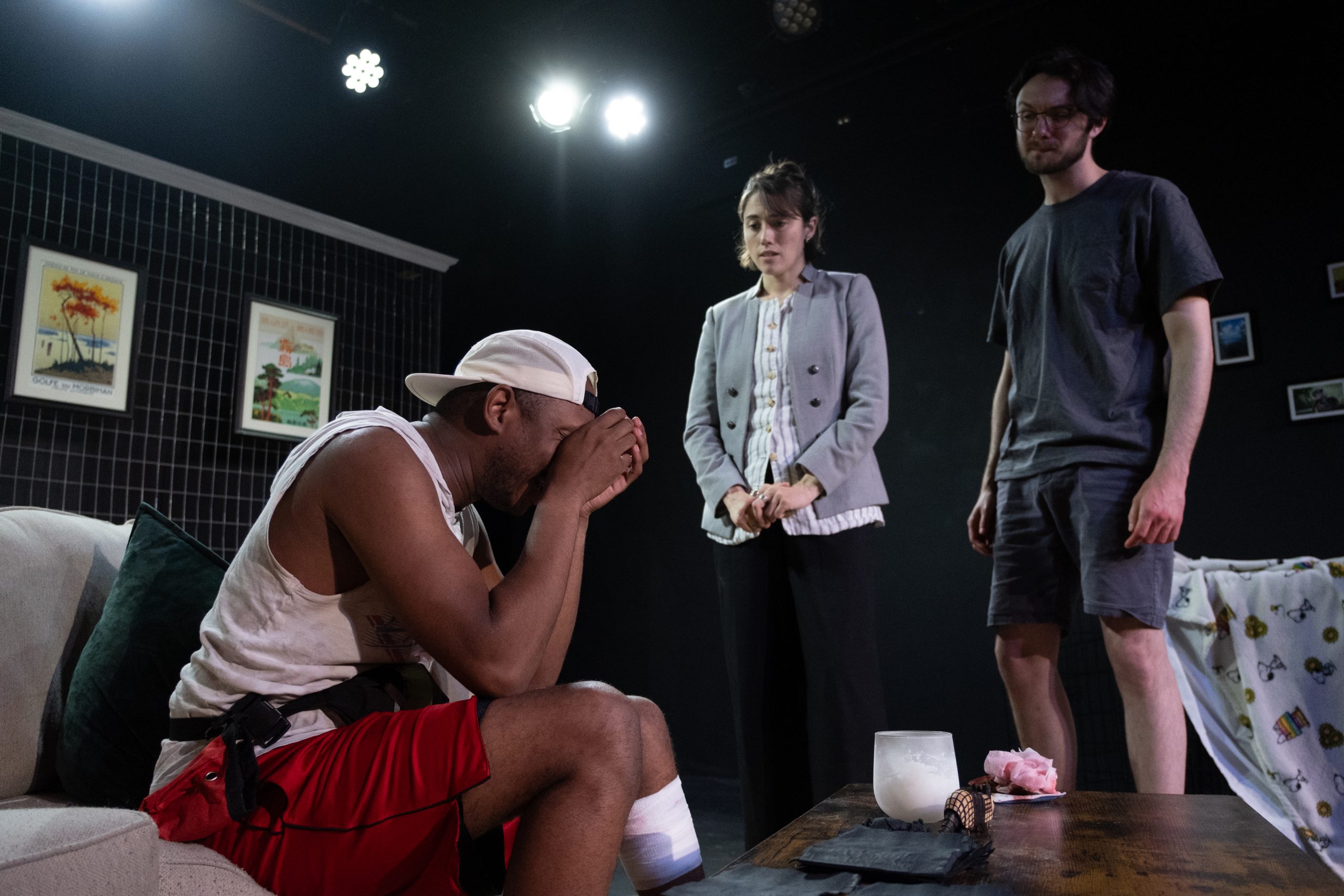
So far as the technical side goes, there is no reason to complain. The set, Michael and Eden’s living room, is serviceable: a couch, two chairs, a bar cart, and posters of world maps that play into Michael’s unrealized desire for travel. One neat trick by scenic designer Nathan Stark is the living room’s back wall, which appears to be black tiles but, closer inspection reveals, is actually wired squares a few inches away from a black backdrop, which gives the audience a see-through effect when Nicole and Bill arrive on the porch. It also mirrors the look of a dog's kennel. Clever.
The script says productions can use or not use a dog on stage. I’m sorry to report there are no real dogs in this production. When the actors refer to Jock, they are either talking to a covered crate or into the audience. Though it’s always a treat to see a cute animal, Ego Death Theater Collective can be forgiven for avoiding that complication. Instead, we’re left with the people and their players, warts and all.
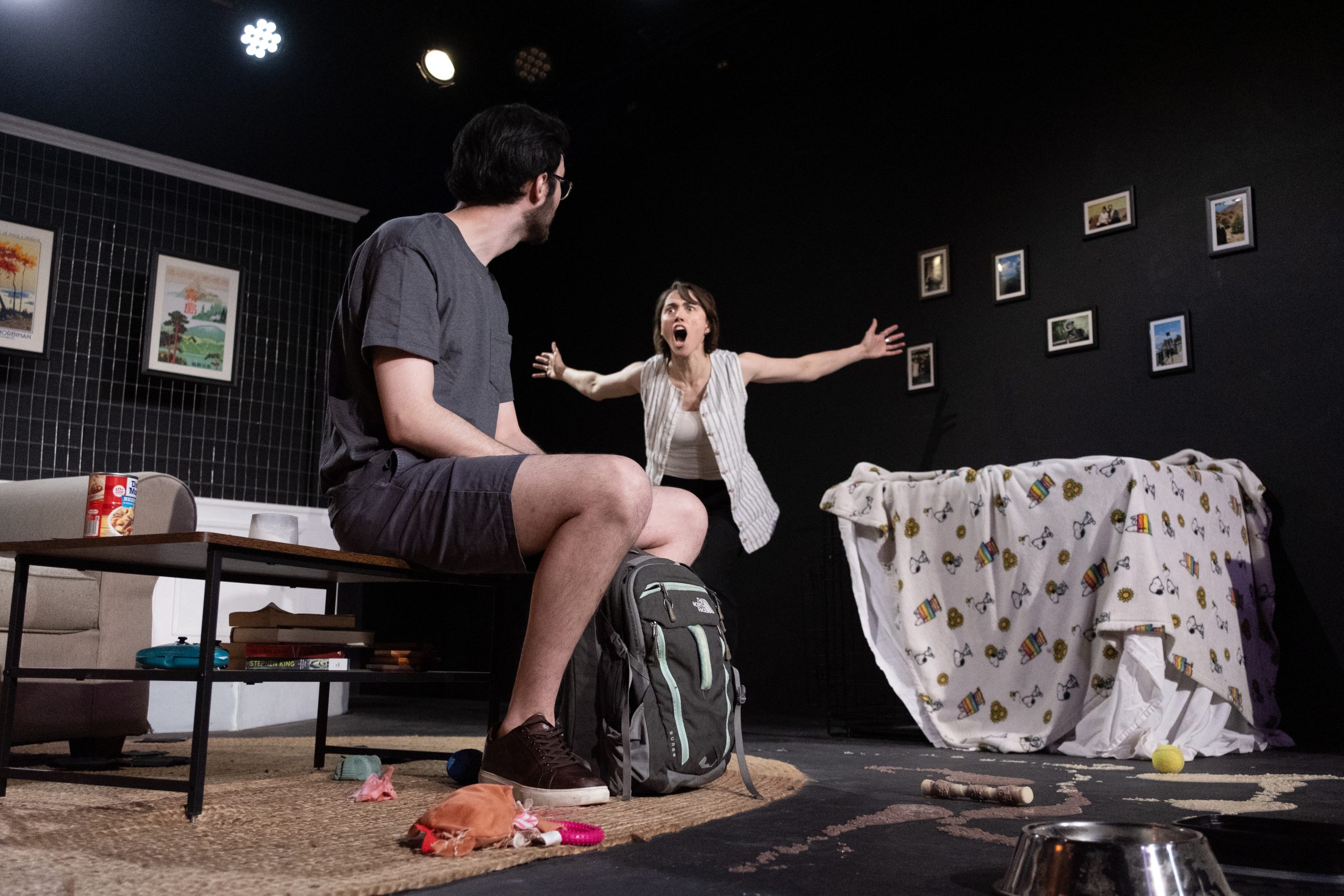
There are character issues, no doubt, but most of those are the author’s fault, while the actors all perform admirably. Eden and Michael argue for almost the entire show. Constant yelling gets monotonous quickly. Just watch a weaker episode of Curb Your Enthusiasm. Perhaps aware of that problem, both actors change volumes and tones often enough to keep us engaged.
In a heated discussion, for example, when Michael explains in gory detail the attack, Eden stops the action, looks disturbed, sits down, and says, “Oh I feel sick.”
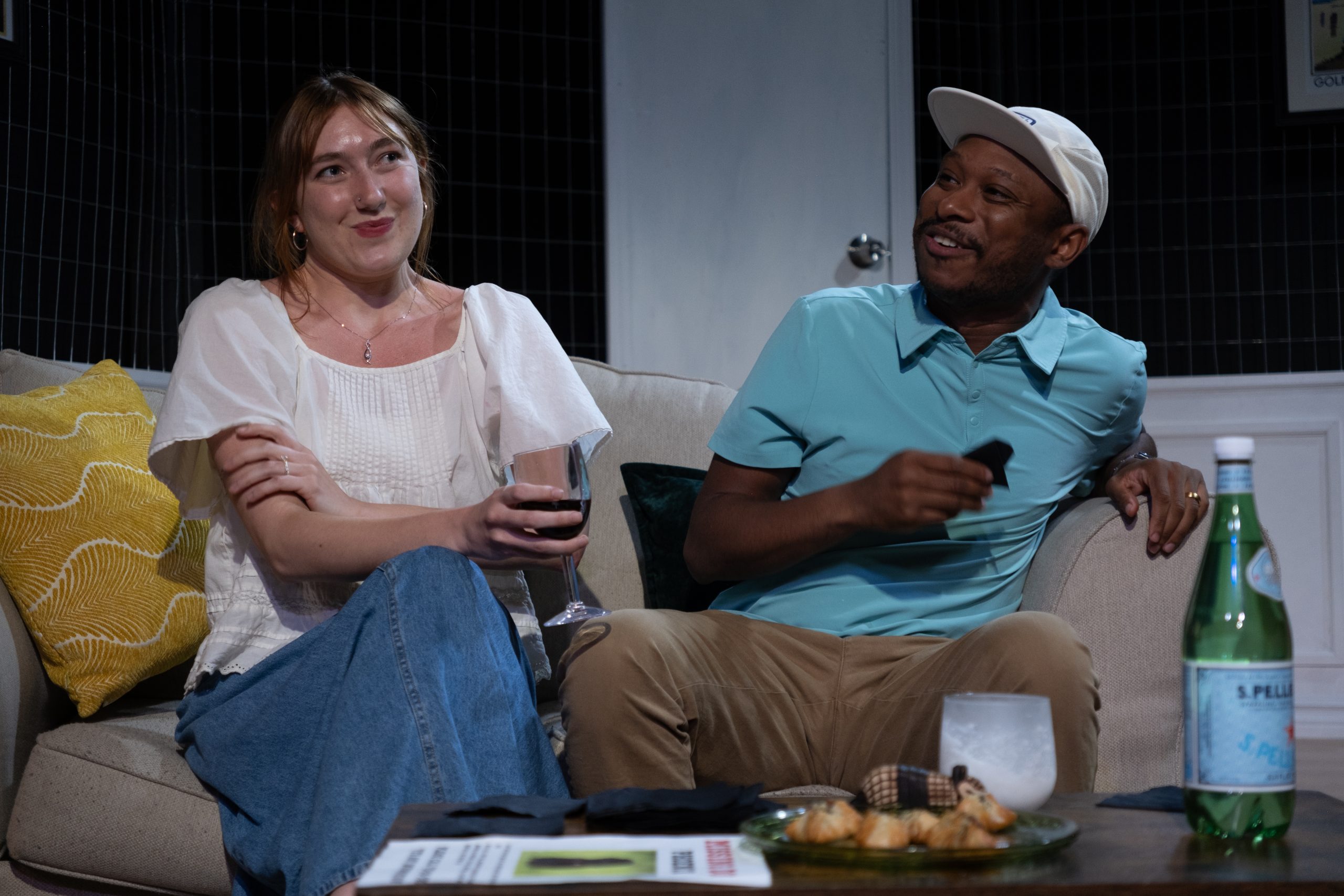
Gorman is not responding to stage directions; there aren’t any in the script. Another actor could have thrown the line away as just another one in the yelling concoction. But she doesn’t, and the show is better because of it. Those changes in rhythm give the material space to breathe. It gives the audience time to lean in.
Without giving anything away, toward the end, Michael delivers a monologue to Jock so full of emotional honesty that it makes the whole ticket price worth it. It will make you tear up, fair warning.
Our mains, however, aren’t flawless. At times Gorman is guilty of what I call “exasperated sigh acting.” It’s an actor’s crutch that, when noticed, can never be unnoticed. Maybe because it gives them a moment to remember a line, actors tend to sigh a lot. People sigh in real life, sure, and maybe some characters would sigh more than the average person. That’s not the point. Even if it is realistic, actors should be allergic to any repetition.
Hradecky, similarly, must pay attention to his uncomfortable laughter. That’s another actor’s crutch which, again, might appear realistic, but becomes grating for anyone who cares about the craft.
Often when judging a performance, one looks for the variety and quality of decisions. How they approach a line, how they change physicality. Which is why repeated crutches are especially insulting. It’s really Lewis, as the tough-guy neighbor and immigrant detention center guard Bill, who does the best job showing the great breadth of decisions actors can explore. He’s in two scenes, but each time his presence is intoxicating.
Like when we Bill examines Jock’s chew toy, “Look at those bite marks. Yeah, see look at this. Sturdy as hell. Indestructible.”
He speaks slowly, voice dripping with suspicion, and holds the toy to Michael’s chest. It’s an odd, intense moment that establishes his character perfectly. Lewis is a terrific actor, but strange inconsistencies with the script drag down his performance.
In Bill’s first appearance, the character clearly suspects something is up with Jock and even seems to clock Michael and Eden as liars. The next time we see Bill, he’s been bitten by Jock while training him with Michael. During that second scene, gushing blood, he is no longer suspicious at all. He’s overly friendly with Michael and Jock, even though the recent biting gives him ample reason to wonder if Jock is responsible for his dog’s death.
The sudden shift doesn’t make a lot of sense. One could argue Bill, acting like Michael’s friend, is relying on his police training to compel a confession. But when Michael gets close to a confession, saying, “We haven’t been completely honest with you. We haven’t been honest with you at all,” Bill isn’t the slightest bit interested, and within a few minutes drops the conversation entirely.
Lewis does a great job all throughout. The only difficulty is he’s a different person one scene to the next. But the actor is not to blame. It seems he’s performing as best he can with a script that changes his character based on whatever is convenient for the story. Another pass from the writer would’ve been useful.
Ultimately, A Dog’s House is a good ol’ fashion dead-dog cry fest. Yes, some issues with the writing and acting make it a less-than-perfect production. There’s still plenty to enjoy for anyone seeking some raw emotion.
Stark's scenic design is enhanced by Sam Bessler's lighting design. Props are by Alex Kulak. Sound design is by Jason Pavlovich. Ash Hoople is costume designer.
A Dog’s House by Ego Death Theatre Collective continues at the Greenhouse Theater, 2257 N Lincoln Ave., thru June 14. Running time is 90 minutes without intermission. Tickets are $29.
For more information on this and other productions, see theatreinchicago.com.
Support arts and culture journalism today. This work doesn't happen without your support. Contribute today and ensure we can continue to share the latest reviews, essays, and previews of the most anticipated arts and culture events across the city.
