
It all began with a short story published in the October 13, 1997, issue of the New Yorker. And then it became an Academy-Award winning film, later an opera, not to mention countless online forums, cartoons, parody posters, TV skits, and magazine covers. Now it is a play with music.
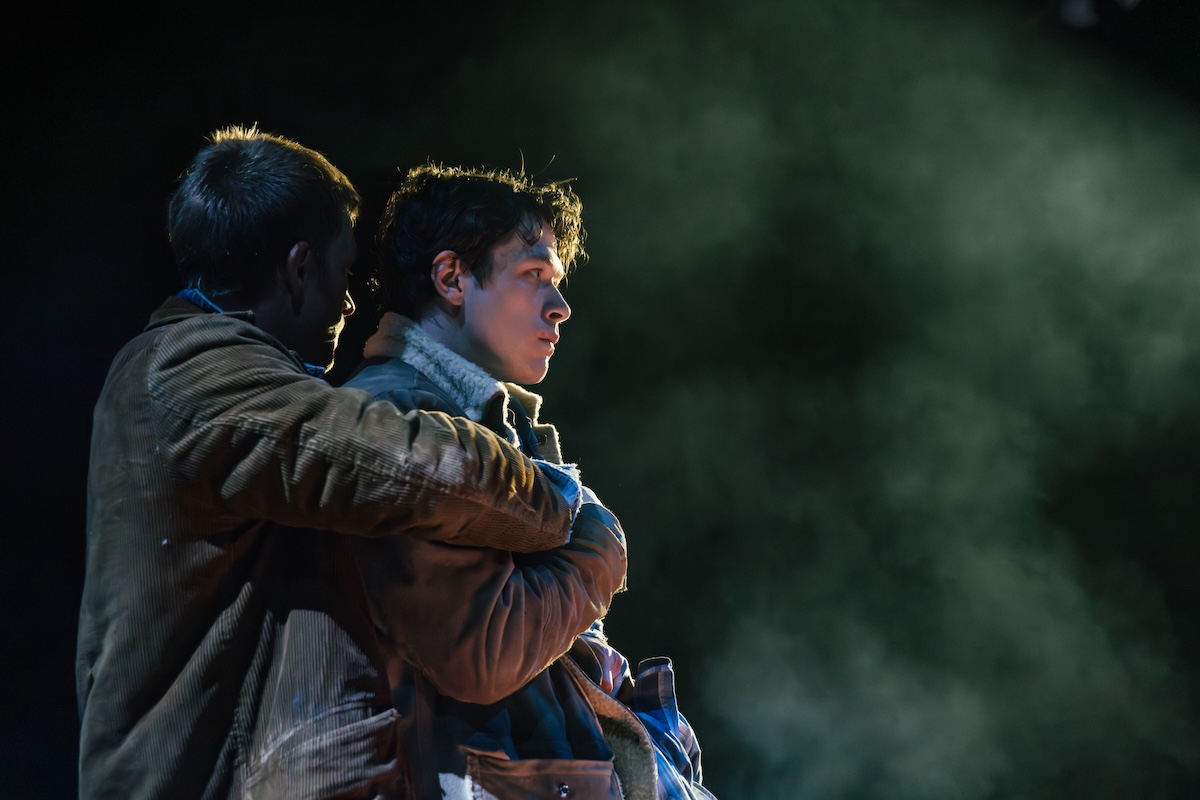
After a successful 2023 run in London’s West End, Brokeback Mountain, Ashley Robinson’s adaptation of Annie Proulx’s short story, received its North American premiere Thursday night in the Courtyard Theater of Chicago Shakespeare Theater. Directed by Jonathan Butterell, the 90-minute play stars Harrison Ball and Jack Cameron Kay as the star-crossed lovers. The ensemble cast includes Thomas Cox, Cordelia Dewdney, Kat Eggleston, and Alina Jenine Taber. Under the musical direction of conductor and pianist/music director Jacob Yates, the production also features a terrific band consisting of Paul Mertens on harmonicas, Tom McGettrick on pedal steel guitar, and Mary Halm on bass. Eggleston does double duty as the Balladeer and Jack’s mother.
Before the play starts, eagle-eyed audience members will notice a man lying perfectly still on a bed. This is our introduction to the stoic Ennis Del Mar, a Marlboro Man suffocated by his inability to communicate, and played to perfection by a tightly wound Harrison Ball. Ennis is as taciturn as Clint Eastwood’s character, the Man with No Name. On the other hand, his opposite, Jack Twist, an effervescent Jack Cameron Kay, initially makes light of Ennis’ stony silence. “Don’t worry,” he says, “I’ll get you to talkin.’” He does. Eventually.
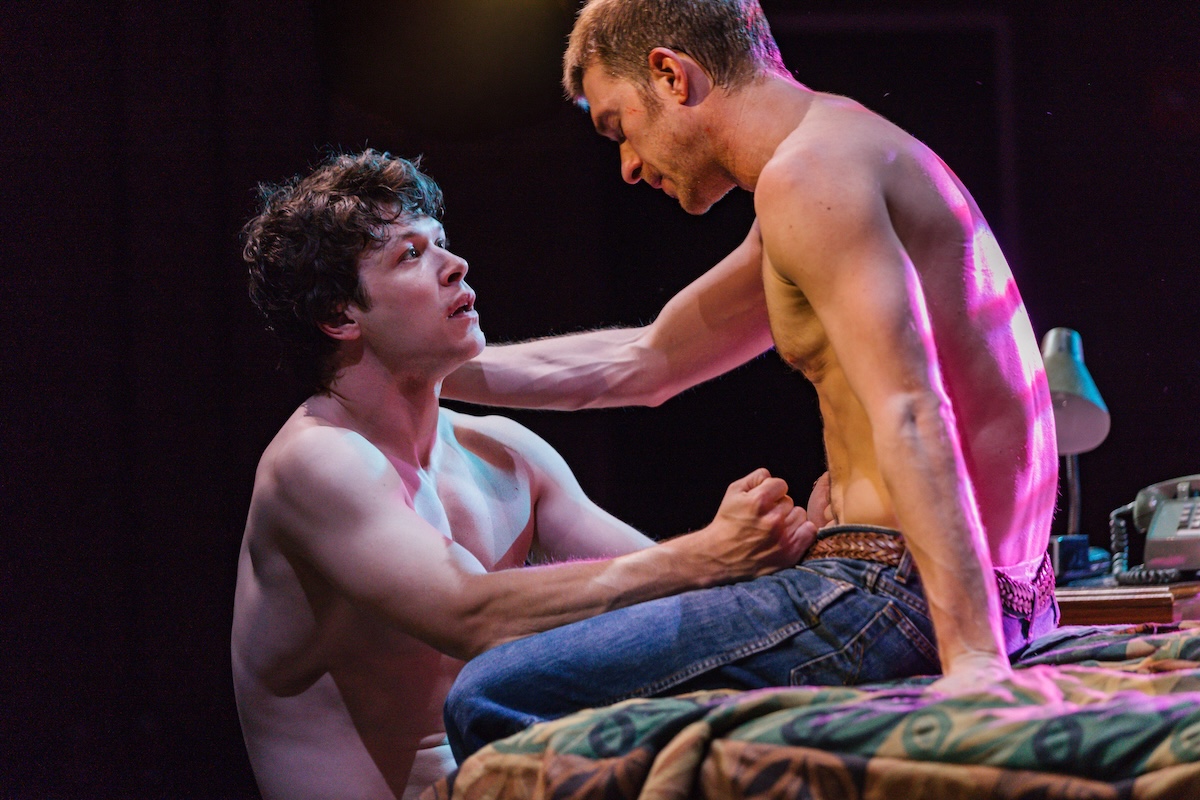
The set design by Tom Pye (who also designed costumes) is simple but effective: in addition to the bed, it consists of a tent, campfire, sagebrush under a starry night, and table and chairs. Nothing more than what is needed. In addition, the lighting design by David Finn as well as the sound design by Christopher Shutt and sound recreation and additional content provided by Stephanie Farina add lovely, if haunting, components to the story. Christine D. Freeburg is production stage manager.
As you probably know, Brokeback Mountain is about the fateful love between two ranch hands who begin a relationship while herding sheep on the eponymous mountain, less romantic nomads and more rustic grudge workers. Both men get married, have children, but continue their furtive relationship over a 20-year span.
Brokeback Mountain has often been described as a gay cowboy story. Of course, it is more than that. It is about many things: the inchoate love between two Western men raised at a time—rural Wyoming in 1963—and in an environment where emotions and affection were discouraged. The two men are trapped by notions of traditional masculinity. After their first intimate encounter, Ennis insists, “I’m not no queer.” Responds Jack, “Me neither.” It is also about poverty and class and homophobia (both internal and external) as well as a poverty of language. They lack the words to express how they feel. On the one hand, it is indeed a love story, but it is a love story of love held at a distance, of love delayed, and, ultimately, of love denied. And that’s what makes it a tragic love story. It is a story about not being able to have and get what you want and for this specific reason, it is really a story about grief.
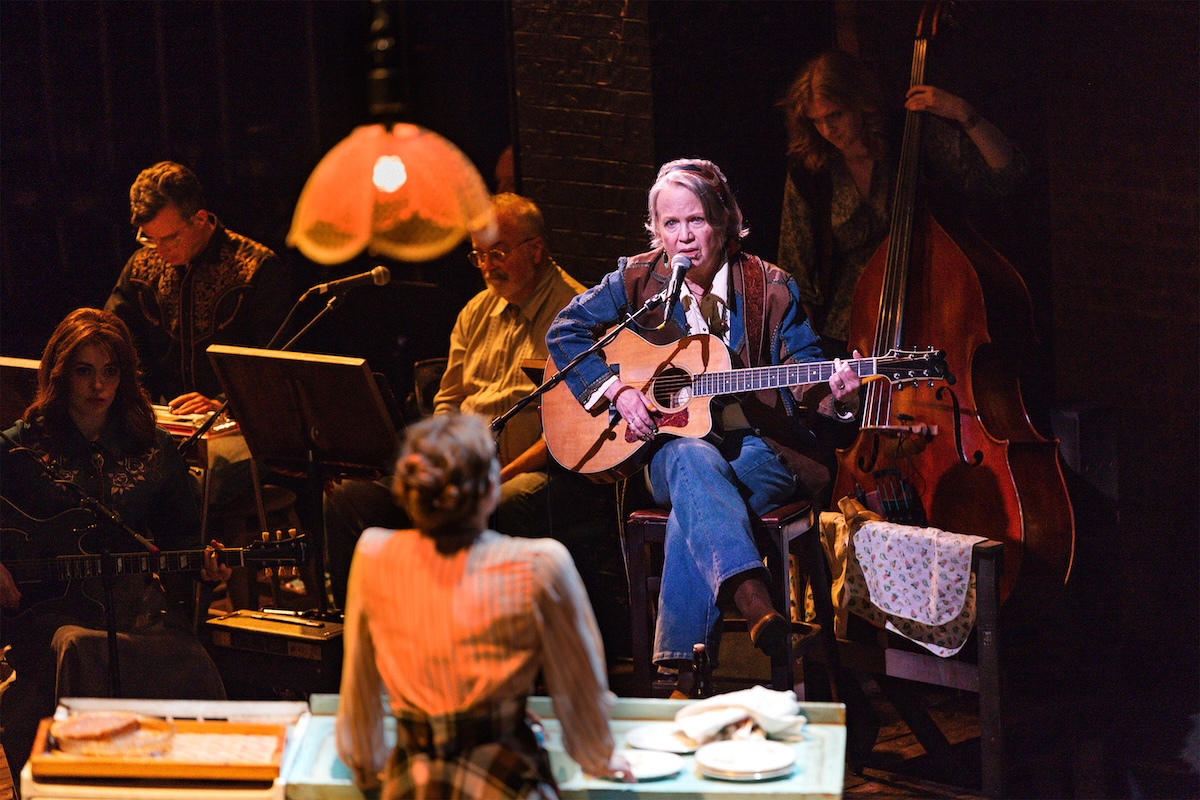
Consequently, the original songs by Dan Gillespie Sells (frontman for the English rock group the Feeling) say things that the characters cannot say, which adds a layer of emotional complexity to the production. Eggleston, a wonderful singer in her own right, is always a welcome presence on a Chicago stage and here in her role as the Balladeer she brings the warmth of her voice, and presence, to the country-folk songs. (In the original London production, the equally wonderful Scots singer-songwriter Eddi Reader, played the role of the Balladeer.) The songs evoke the loneliness of a Hank Williams song, the harsh beauty of the landscape, the howl of a coyote, the vastness of the terrain, the emptiness of a broken heart.
On the other hand, I found the play surprisingly funnier than expected. Much of the humor emerges from the performances, especially the way Kay finds the comedic elements in Proulx’s plainspoken words, in his cadence and his phrasing.
Like Wallace Stegner, Ivan Doig, Norman Maclean, A.B. Guthrie, and Gretel Ehrlich, Proulx follows in a long line of Western writers who portray the real West, not the mythic, romanticized West. Thus, Proulx’s Brokeback has more in common with, say, Larry McMurtry’s The Last Picture Show, his bleak portrait of windblown, small-town Texas in the early 1950s. (McMurtry, who co-wrote the Brokeback screenplay, was the son and grandson of ranchers.) As it turns out, in their roughhewn beauty, the publicity photos of the two actors make them resemble Wild West outlaws such as Billy the Kid, Jesse James, or Butch Cassidy and the Sundance Kid.
Essentially, what Proulx does best, and what Robinson does here, is capture the essential loneliness of the West and the western experience. Solitude breeds quietness and, thus, a few words spoken take on profound meaning. But whereas Proulx’s short story is all understatement, gruff and gritty and rough, Robinson’s interpretation––through the actors and the dialogue—fleshes out the characters and their emotions in a way, subtle though they may be, that humanizes them. The lonesome prairie dialogue of the two men—at times spoken in a low mumble and full of Western twang and cowpoke jargon—evokes a particular time and place. It helps too that the lead actors are immensely likable. We care about them.
Brokeback, the fictional mountain of the story, is a multi-layered metaphor that represents many things: freedom, escape, refuge, unattainable love during an idyllic summer. What was, what might have been. As Jack reminds Ennis, they never went back to Brokeback. At one point late in the play, Jack’s wife, Lureen, wonders if Brokeback even existed. Knowing Jack, she says to Ennis, “it might be some pretend place where the bluebirds sing and there’s a whiskey spring,” a line that evokes Harry McClintock’s 1928 song “Big Rock Candy Mountains,” about a hobo’s idea of paradise.
Because of the iconic status of the film, certain lines linger beyond the screen, or the page, for that matter, as when Jack in a moment of exasperation says to Ennis, “I wish I knew how to quit you.” (I have a magnet that depicts the famous pose of the two men under a variation of the phrase, “I’ll never quit you.”) The many who have seen the film might find it difficult to get Heath Ledger and Jake Gyllenhaal out of their minds but, to me, this production stands on its own. Powerful, memorable, poignant, elegiac. And, yes, the tears did flow.
As Ennis would say, “If you can’t fix it you got to stand it.”
Brokeback Mountain runs through June 28 in the Jentes Family Courtyard Theater at Chicago Shakespeare Theater on Navy Pier. Running time is 90 minutes with no intermission. Tickets ($110-$120) and more information are available here.
For more information on this and other productions, see theatreinchicago.com.
Did you enjoy this post? Please consider supporting Third Coast Review’s arts and culture coverage by making a donation. Choose the amount that works best for you, and know how much we appreciate your support!
