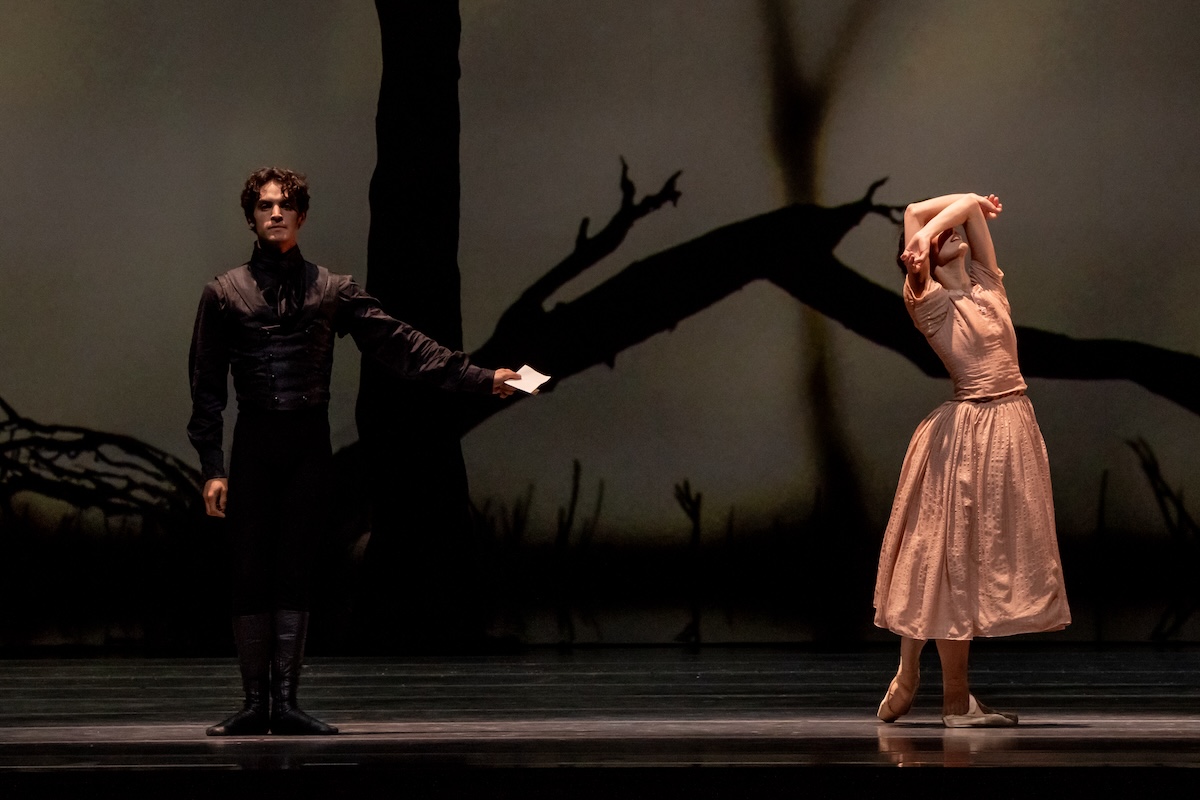

The Joffrey Ballet is concluding its 70th season with a superb production of Eugene Onegin, based on Alexander Pushkin's 1833 novel of the same name. This is a premiere in co-production with the San Francisco Ballet, choreographed by Yuri Possokhov, music by Ilya Demutsky, and libretto by Valeriy Pecheykin. I sat spellbound, watching a flawless performance by one of the finest ballet companies in the world. This performance is masterfully directed by Ashley Wheater, MBE.
Eugene Onegin tells the story of an emotionally detached aristocrat who believes he is incapable of love. Onegin is danced by José Pablo Castro Cuevas, and he is faultless in the role. Cuevas was also the principal dancer for Joffrey's production of Frankenstein in 2023. I recognized his form immediately, technically perfect, with an added ferality that underscores the depth of Onegin's repression. His grand jetés with entrechats are a study in skill and passion. Also, Possokhov's choreography weaves in a couple of grand pas de deux with each of the main couples.
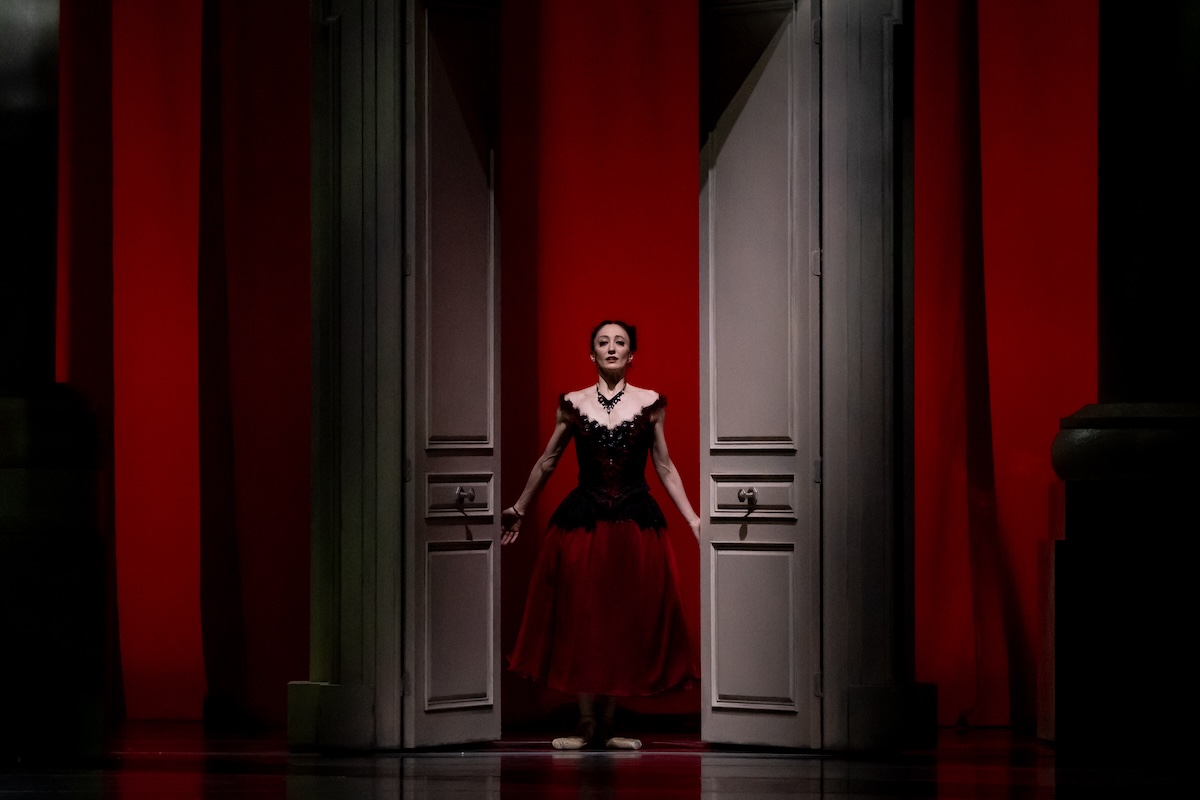
Cuevas's Onegin has a wonderful chemistry with Victoria Jaiani, who dances the role of Tatiana. Jaiani immerses herself in each character for which she dances as principal. Her Carmen was as elegantly decadent as her Tatiana is innocent and stricken with love for Onegin. Her willowy arms and legs evoke the wooded land where the ballet is set. In my opinion, Jaiani has defined the role as it should be danced. The roles have been choreographed for a darker storyline. There are pauses for Cuevas and Jaiani to face the audience as if in a framed portrait that comes to life.
The role of Tatiana's sister, Olga, is danced by Yumi Kanazawa, and Olga's beloved, Vladimir Lensky, is danced by Hyuma Kiyosawa. Kanazawa beautifully portrays the youthfully hopeful Olga. Possokhov has both young lovers dancing with a different kind of abandon; there is a naivete to their steps. Kiyosawa also performs grand jetés with entrechat, but they have a gleeful bounce. Vladimir is a young man in love, whereas the same moves by Cuevas are more akin to daggers. The grand pas de deux of Olga and Vladimir projects a woman being lifted and declared as the intended or forever love. Onegin and Tatiana have the tension of a woman's desperate love, and a man interested in the carnal but desperate to contain any notions of love.
Eugene Onegin is divided into seasons, with passages of Pushkin's poetry introducing each scene. The dancers who introduce or accompany each season are portrayed as spirits. Pushkin used vivid metaphors with both texture and visual effect. The costumes change color, and the spirits take on a somber tone. In summer, energetic male spirits enter the forest in bright red and excitedly whip off their shirts. Even the costumes are part of the choreography with the Joffrey. At one point, the forest spirits form a mass that moves in time with a heartbeat and has a central opening.
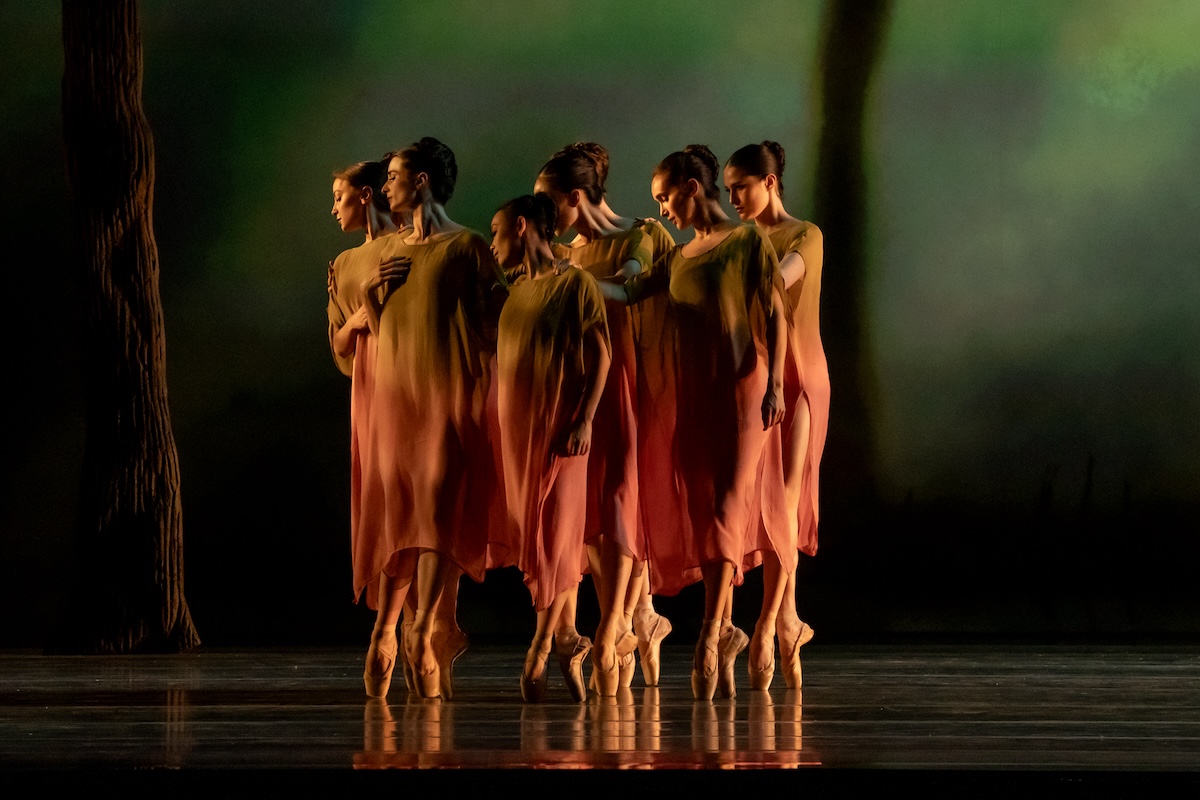
I interpreted the spirits as sylphs floating in gossamer attire against stunning backdrops. I saw them as anthropomorphized elemental beings. Tim Yip's costume design is glorious, and Tom Pye's scenic design is exceptional, with cyc wall tones I have not seen. Autumn and winter are particularly beautiful. It looks like a Kodalith print with sepia hints from Jim French's subtle lighting design. The murkiness of the spring forest hints at fecundity and mystery. Finn Ross's projection design is beautiful. The projections that look like charcoal drawings drew you further into Onegin's despair. I loved that I could hear the taffeta of the costume dresses rustle.
Wheater's direction is brought to life by Adam Byde's impeccable staging, which combines timing, cues, and the spatial relationship between the set and the performers. One scene in particular, when Olga and Tatiana await the outcome of the duel between Vladimir and Onegin, is spare and deceptively simple. The walls are aqua-green and unadorned, except for a bench and a door. That sparseness enhances the emotionally taut anticipation.
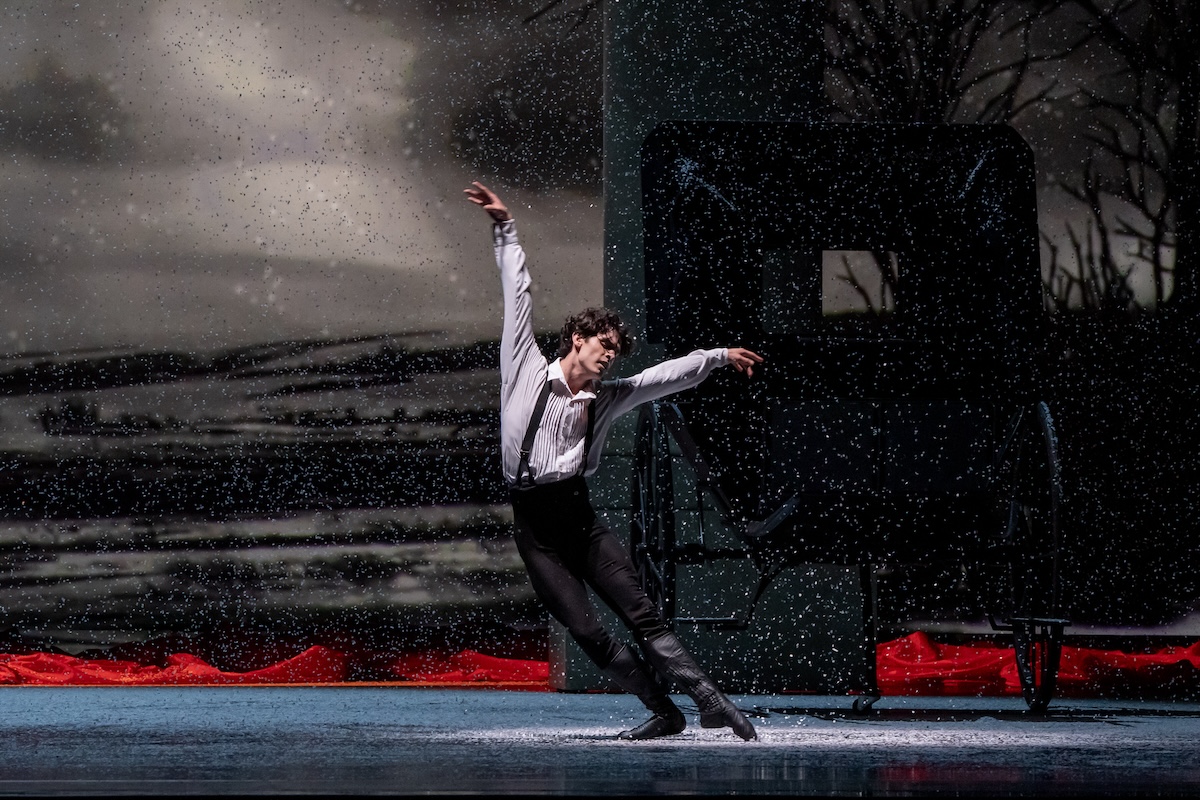
Kiyosawa's solo dance as he waits for the duel to begin is a portrait in agony. He is tormented by his best friend's actions, but honor-bound to avenge the insult of Onegin making a play for Olga. Cuevas's solo is the finale in which all the elements converge. Billowing, blood-red curtains fall to reveal the charcoal portrait of winter. Cuevas is dressed in black and white while the snow falls.
Demutsky's score is dramatic and beautifully melodic. Pecheykin's libretto takes Pushkin's verses and creates a beautiful narrative that relays the emotions of happiness, grief, passion, and regret. All of this comes together to create what is now one of my favorite ballets. Eugene Onegin is not to be missed. Four Stars
Joffrey Ballet's Eugene Onegin runs for 2 hours and 20 minutes with an intermission, and is now playing at the Lyric Opera House, 20 N Wacker Drive. Tickets ($48-$192) and more information here.
For more information on this and other productions, see theatreinchicago.com.
Did you enjoy this post? Please consider supporting Third Coast Review’s arts and culture coverage by making a donation. Choose the amount that works best for you, and know how much we appreciate your support!
