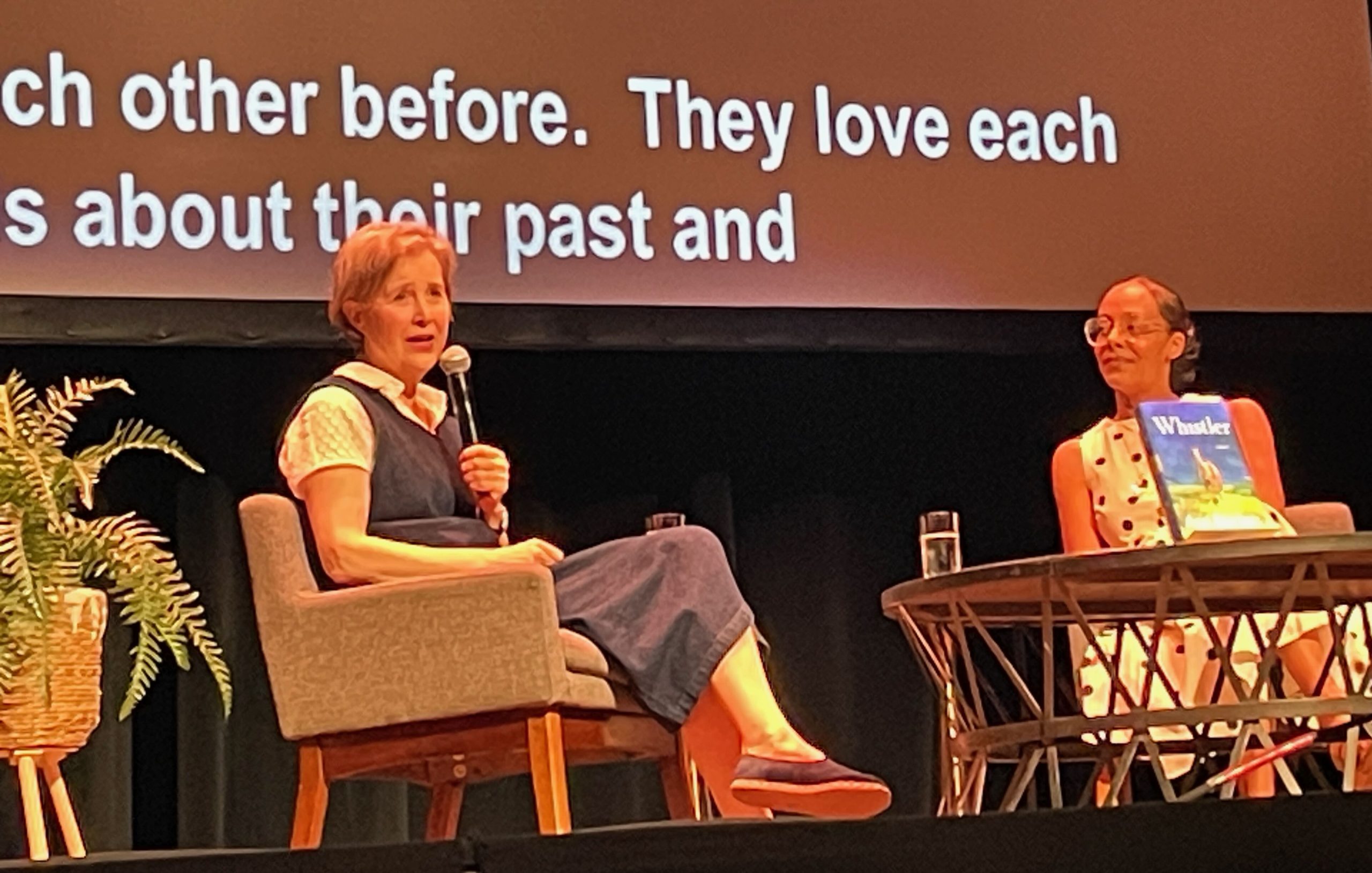
A sold-out assemblage of Ann Patchett fans, most of them women, attended her book launch event Sunday at the Athenaeum Center. Patchett discussed her 10th novel, Whistler, with publishing executive Lisa Lucas. The event was part of the Chicago Humanities Festival spring series, in partnership with Women and Children First bookstore.
Patchett writes intensely human stories about people you might know—or would like to know. The book is a story of family connections lost and found, memory, love and small moments that can change a life. The defining point of the story occurs when Daphne, a high school English teacher, and her husband Jonathan are visiting the Metropolitan Museum of Art in New York. Jonathan, looking over his shoulder, says quietly to Daphne, “Old guy. Near the exit sign.” “Stop it,” Daphne says, thinking it’s a joke. But Jonathan persists and finally goes to chat with the older man. He brings him over to introduce him to Daphne as her first stepfather, Eddie Triplett, who was married to her mother for only a year.
It turns out that Daphne and her younger sister Leda remember Eddie with fondness. Daphne and Eddie shared a could-have-been-fatal accident and were bound together by fear and love. Eddie, his leg seriously injured, told stories to 9-year-old Daphne to keep her comfortable until help arrived. Soon after that, Daphne’s mother broke off her marriage to Eddie (“because he nearly killed you”) and he disappeared from Daphne’s life for 45 years—until that fateful day at the Met.
Daphne had forgotten about Eddie years ago. “After the end of childhood, I had failed to imagine him at all,” she says. When they are reunited, it’s a family reunion of sorts. Daphne realizes how very much she loved him and has missed him over the decades. Eddie, who still works as a publishing house book editor, and Daphne renew their relationship and become fast friends and frequent companions. That’s when Daphne learns why her mother really divorced Eddie.
A friendship can be really close, almost romantic, in such a “happy, happy way,” the author says. She dedicated Whistler to her late friend Jim Fox, who used to work as legal counsel at HarperCollins and died in 2024, to emphasize the idea of love and friendship. He wasn’t my stepfather, Patchett said, “Although I did have two terrific stepfathers in my life.” Lucas commented that the novel plays against “stereotypes of wicked stepfathers.”
Daphne and her sister Leda, who was 6 at the time of the accident, have different memories of Eddie, although Leda also remembers him lovingly. “Memory is fascinating—and completely unreliable,” Patchett said.
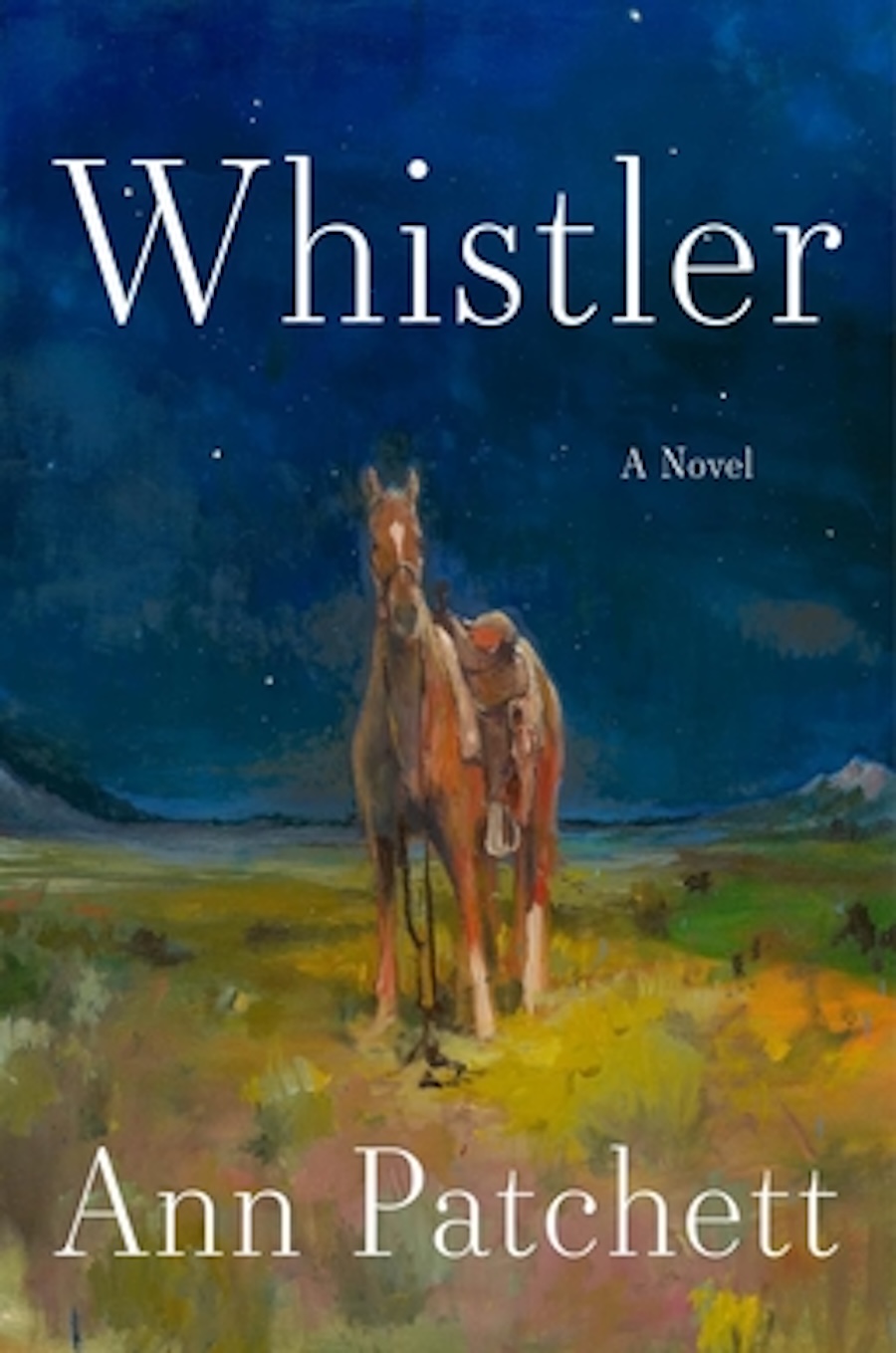
The book’s cover image is a portrait of a horse named Whistler, who learned to come for his owner when she whistled for him and thus saved her after she was injured in a riding accident. Eddie tells Daphne the Whistler story while they are confined in the wrecked car. Whistler’s story, however, only takes up a few pages in the book and isn’t mentioned after that and it seems odd that the cover portrays a horse.
Asked by Lucas about authors she admires, Patchett noted that she thinks about Elizabeth Strout every day. I admire her because “she’s writing complex, accessible books,” Patchett said. Strout is the author of the Olive Kitteridge and Lucy Barton books; her latest books are Tell Me Everything and Things We Never Say. Most of her stories are set in Maine, where she grew up.
Patchett is co-owner of Parnassus Books in Nashville and frequently records short “New to You” videos in which she recommends recent books. You can find her videos on YouTube.
Her books and those she recommends are considered to be in the category of literary fiction; she considers them nice books about kind, happy people, not “the kind that punch you in the face.” She has referred to her own books as "good, smart literary fiction that will not crush people’s souls.” She said on Sunday that she “sees so much kindness wherever I am and I think that it is underrepresented in literature today.”
Continuing in that vein, she said, “I have come to think that cruelty, anger and complaining are low-hanging fruit. Take a moment to think of all the people who have been nice to you today and reach a little higher.”
On that note, Helen Schulman’s review of Whistler in the New York Times asks, “Is there a place in serious literature for kind, happy characters and kind, happy stories? This intimate and entertaining novel makes the strong case that there is; as demonstrated across her work, such sturdiness of spirit is part of Patchett’s generous worldview.”
After discussing the book, Lucas asked Patchett what her priorities are as a “literary citizen.”
Patchett replied that her priority is the people who work in the bookstore. You can’t save the world, she said, but you can take care of the postage-stamp part of it that’s in your backyard. Parnassus Books has a foundation that buys books for Title 1 schools that don’t have funding to keep their libraries well stocked.
About the Book
I have some concerns about the book. For instance, if Eddie and Daphne were so close at the time of the accident, wouldn’t one of them have tried to find a way to reconnect over the years? Even though Daphne had a father and two stepfathers, she must have thought of Eddie occasionally. And it’s not like they were living in the era of printed telephone directories and “Hello Central, give me Heaven.”
Second, there’s the Whistler title and the horse portrait book cover. I’m not going to suggest a better title, but I think there has to be a more appropriate title and appealing image for the novel. (And if you are a horse lover, no, it's not a book about horses.)
Third, the book is a lovely read and it’s only 300 well-spaced-out pages. I read it in my spare time over two days. But it is sweet and a bit saccharine, as most of Patchett’s books are, in my view. I’ve read two Ellizabeth Strout books and had the same reaction, so I was not surprised when Patchett said she admires Strout so much.
I do think everyone needs a kind, happy book about kind, happy people every now and then. But for my regular literary diet, I prefer books with some edge, even a bit of malevolence. I’d love to hear what you like to read if you would leave me a note in the Comments.
Whistler by Ann Patchett is available from the publisher or your favorite bookseller. See the CHF website for information about coming Chicago Humanities Festival events.
Did you enjoy this post? Please consider supporting Third Coast Review’s arts and culture coverage by making a donation. Choose the amount that works best for you, and know how much we appreciate your support!
