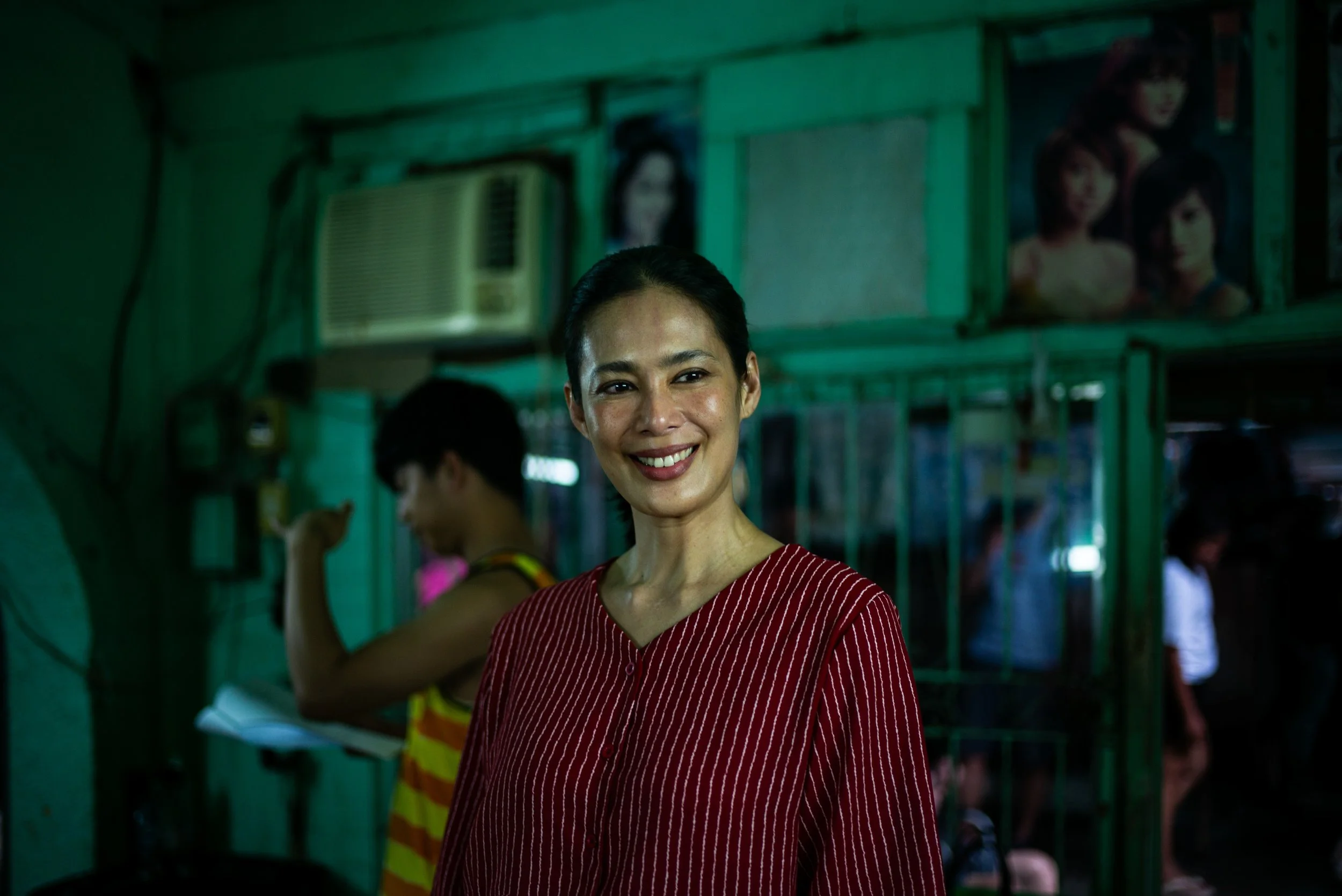
This article was written by Thomas Hodgkins.
The Asian Pop-Up Cinema has recently concluded, with films from all over Asia screening for audiences in Chicago. One of the festival’s highlights was a screening of April, directed by Taiwanese filmmaker Freddy Tang and featuring Filipina actor Angel Aquino.
The film follows a Filipina caretaker named April, who works in Taiwan. When April’s mother falls ill, she must return home to the Philippines with the man she is looking after. The man’s son finds out that his father has left Taiwan, while April must face the fact that she hasn’t seen her family in years.
Aquino, who has been acting in the Philippines for multiple decades, received the Pinnacle Career Achievement Award at the screening. I had the chance to sit down with Aquino to talk about April and its depiction of duty, sacrifice, and motherhood, as well as what it means to her to receive an award in the United States.
My first question is about what first drew you to this project and this role, specifically.
I auditioned for it. So thankfully, I got in. We were shortlisted to three actors, and then, after a while, they decided to go with me. So that was really lucky.
Is there anything specifically about when you first auditioned that drew you to the role of April, specifically?
I like the challenge that it's a foreign production, working with other people, and also because the character requires me to speak in another language. That was something that was very curious for me, and I wanted to see if I can take on that challenge. Thankfully, I was given enough time to memorize and actually learn some of the lines that I needed to say in another language.
You mentioned this is a multicultural production. Did you film both in the Philippines and in Taiwan?
Yes, I was the only Filipino actor who filmed in the Philippines and also in Taiwan. I wish I could bring my family, the actors who played my family in the Philippines, to Taiwan, but it was only April who got to go.
A lot of this movie is about sacrifice and obligation and duty. How did you approach that part of April's character and her beliefs on sacrifice? How did you approach balancing that portrayal of duty to her grandpa and to her actual family?
Well, that wasn't hard for me to draw out of me, because I'm a mother, so I know how it is to have responsibilities and family duties. But I guess caring for the elderly and other people who are actually strangers, is very innate to Filipinos. I had to study, though. I went to Taiwan for a few days to see the actual April, because this was actually based on a real person. And I had to learn how she takes care of her own aging.
I think maybe my favorite part of the movie was April's arc as a character, arc as a mother and coming to terms with her kids growing up and becoming their own, independent person. Did that resonate with you—that part of her character—and how did you approach that as well?
Oh, definitely. Because I have daughters who are full-grown adults. One is 32, and one is 30 years old. So I know how it is to have a full-grown child. I know how it is to have full-grown children. And whether or not they grew up with you, there's always the struggle of seeing or getting to know a totally different person apart from you. My daughters grew up with me. They lived with me all their lives, but I am getting to know them as individuals. And so April, coming home from Taiwan and being away for more than 10 years, also had that challenge of getting to know her children from square one, because, when she left, they were still very young, but now they're full-grown adults with their own ideals and principles and quirks, and she had to learn them.
I definitely thought that was one of the most emotional parts of the movie. And there's a lot of different emotions throughout the movie, but there's also a lot of funny moments. Do you think that it's important to have these moments of humor in a movie where there's a lot of emotional things?
I think that you need a breather every now and then. Especially if it's very emotionally laden, you have to have those moments where you just don't want to think and don't want to feel too heavy. So, yeah, it was nice that both sides, the Taiwanese story and the Filipino story, both had those humorous moments.
What did this movie teach you about yourself? Portraying April, did that teach you about yourself?
Well, more than finding out things about myself, it's really getting a closer look at how the Filipinos who work abroad, who are away from their families, away from their children and their parents, how that feels, and their struggles and their plight as somebody who has to take care of other people or be a stranger in a country and have to adjust to another culture. So I think that was my takeaway.
If you could talk to April, what do you think you would say to her?
That she made the right decision of staying and being with her family. Because, after all, God provides. Because a lot of us, we leave because we need to provide for our families. We want a better future for our children, but maybe if we trusted life a little bit more, we probably don't have to do that. But I know that's hard. It's a hard decision to make, because if you lived in the Philippines, you'd understand what I'm talking about. Life there isn't easy, but we all try to make do and try to survive with whatever life gave us. So, yeah, I will tell her that, ‘Hey, good job. You've tried to be away and give them a better life, but maybe you'll be giving them your better self if you stayed.’ And I'm glad that she stayed,
You mentioned that taking care of the elders is a big part of Filipino culture. Do you think that Filipino culture is important in the other parts of the movie, such as April's choice to commit to being with her family and staying there? Do you think that's a big part of it, too?
Yeah, because I think that it's universal, our love for family, because that's what happened with Ah Wei also. He decided he will bring home his father and a real relationship with him. So I guess the love for parents, the love for your children, is something that's universal. The Filipinos' love for their families is not different from how you love your own parents and siblings and all that. So yeah, it's very important that we showed that, because it's something that everyone can relate to.
I know you're receiving the Career Achievement Award. Congratulations. What does that mean for you to receive an award like that?
It hasn't sunk in. It’s so weird for me to be receiving an award outside of my country. But it is something that will be given by my own countrymen here, fellow Filipinas. So that's a nice touch for me. But also, it's something I should be proud of. But right now I'm still trying to understand how it happened, why I deserve it, but I'm glad that they see what they see. So thank you for that.
Do you think it means more that it's from another country, that you're here in Chicago, and in the United States in general?
It definitely has a different impact. It's a different meaning for me. It's a bragging right, something maybe I can brag about, but won't. But, yeah, I accept the honor, and I am thankful for it. Life just dishes out so many different things to you. So, yeah, this is something that I wasn't prepared for, but really, really happy to receive.
How do you think that your career and all the work that you've done in the Philippines has led to this? Not just this award, but also to April. How did your previous roles prepare you for this?
I guess it's been my choices of roles and projects that earned me this recognition. I have been lucky, but also, it was a conscious effort for me to choose my projects well because I didn't want to do things I didn't really believe in, or did not resonate with me, or did not align with my beliefs.
Do you hope that this movie and the festival both shed light on different movies from Asia, or also the Philippines and Taiwan specifically?
Yes, because I think that these are stories that would be nice to be seen by other cultures and other people, because we all have different stories to tell, and it will give you a different perspective, and would help you understand how things happen in other parts of the world. So I'm really glad that the films now have become more universal, and also are getting more exposure to other parts of the world, because the world is getting smaller and smaller. So it's nice to know something that you're a stranger to and get to know it better.
The movie's going to be showing tonight at the festival. What do you hope an American audience can take away from this movie?
Well, first of all, I hope that hopefully more Americans would watch it, not to see me, definitely not that. It's just to see the story and to experience it. And I hope that they see, as I've said, how love for family and others, is very universal. So that's really the only thing that we can take away from these kinds of stories.
Was there anything else you’d like to add?
I hope that there will be more venues for films from different parts of the world to be seen and showcased here and in other countries. I wish that there will be more exchange of arts and stories and films, between cultures and between people, because that way we get to understand one another better, and then maybe we'll stop being at war with each other, and just really understand humanity more.
If you enjoyed this post, please consider supporting Third Coast Review’s arts and culture coverage by making a donation. Choose the amount that works best for you, and know it goes directly to support our writers and contributors.
