

I have seen Luis Ortega’s Kill the Jockey (El Jockey) twice this year and am still in awe at the big swings it takes, how it keeps audiences on their feet. Its tonal and stylistic shifts are as fluid as the titular jockey’s gender identity. From the English title itself to its use of crime and sports movie styles, Ortega’s eighth feature defies any expectations we may bring walking into it. It is also incredibly erotic, the perfect antidote to the hyper-macho antics of F1.
Just like Sonny Hayes in F1, jockey Remo Manfredini’s (Nahuel Pérez Biscayart, 120 BPM) best days are long over. He still may headline some of Buenos Aires’ most competitive horse races, but he is being literally left behind by his pregnant partner Abril (Úrsula Corberó), who is winning far more races than he is. Not that he cares. He now walks through life in a self-destructive alcohol- and drug-induced haze. After falling off his horse at the start of a race, his sponsor Rubén Sirena (Daniel Giménez Cacho, Bardo and Zama), a businessman and gangster who has a penchant for carrying different babies from unknown precedence as an accessory, delivers an ultimatum. He has just purchased an extraordinary horse named Mishima that is being flown straight from Japan for Remo’s next race; Remo must win the race or else. To ensure that Remo stays drug- and alcohol-free, Sirena and his henchmen lock the jockey and his wife inside a stable prepared for them until the race.
So far, so straightforward, right? Not so fast.
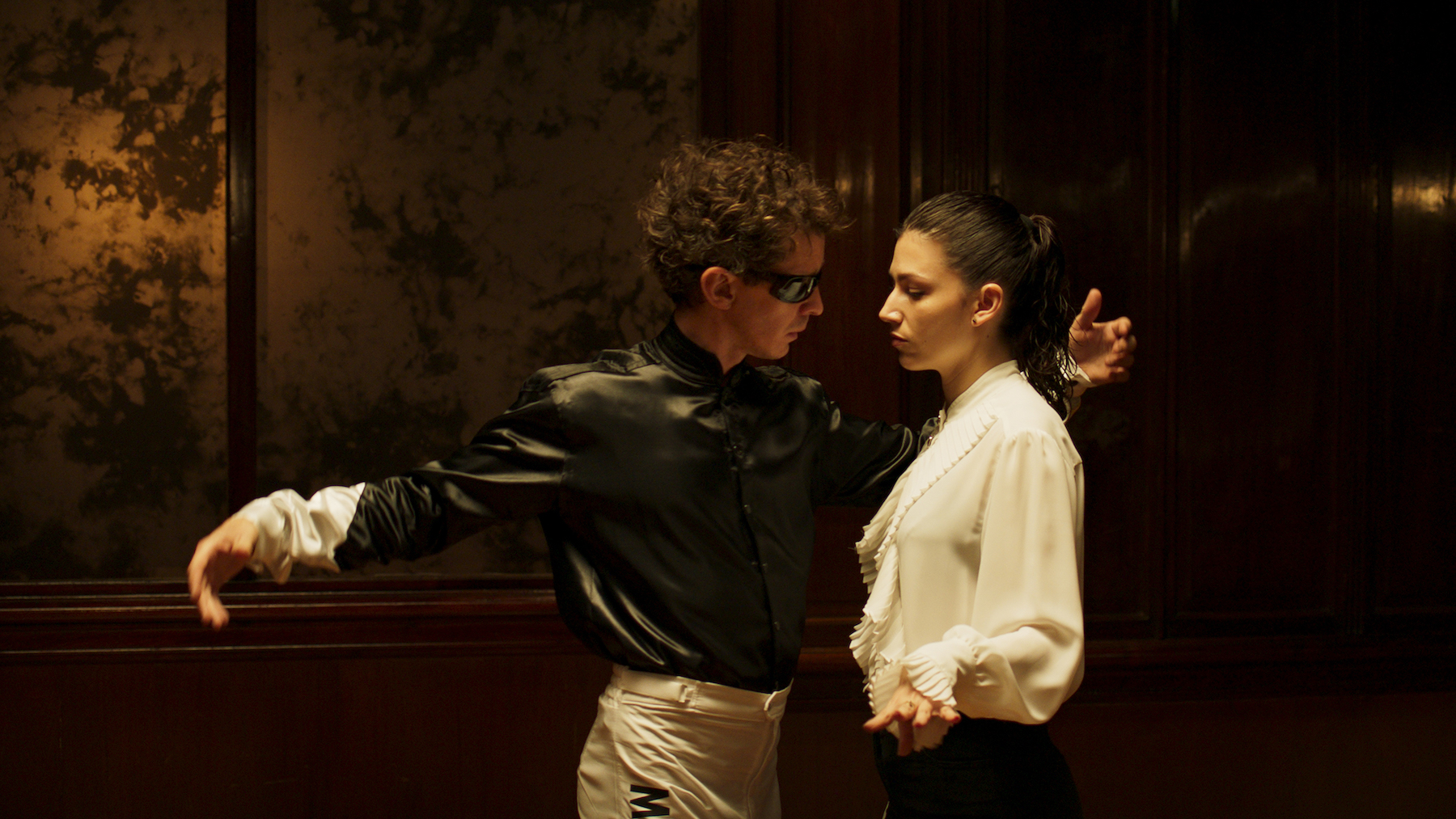
Between the opening scene where Remo is found drunk out of his wits in a Buenos Aires bar to that pivotal race with Mishima, there are two erotically charged dance numbers, one of them featuring a whole roster of women jockeys and a duet between Abril and future lover Ana (Mariana Di Girolamo, Ema), choreographed to electronic music, and an equally erotically charged conversation between a fully dressed Sirena and a group of naked jockeys in a steam room prior to the race. The film may take place in present times, but the wardrobe, the room furnishings and even the fabulous soundtrack full of '60s and '70s pop music from such Latin American and Spanish idols of the time as Sandro, Palito Ortega (the director’s father) and Nino Bravo suggest a parallel world stuck in time, no matter how much Remo and these female jockeys may be dancing to synthesized beats.
A doped-out-of-his-wits Remo drives Mishima off the racetrack and into oncoming traffic after jumping a fence. The next time we see him is in a hospital bed, in a coma, his head bandaged in the form of a beehive; his chances of surviving this horrible “accident” are minimal. Or that’s what the doctors think. Remo suddenly wakes up, puts on a woman’s mink coat and handbag, and walks out of the hospital into the streets of Buenos Aires.
Early in the film, Remo wishes he could die so he could be born again, and it is obvious that we are witnessing this process as he transitions and is reborn as Dolores after a violent incident involving Sirena and his henchmen. The “kill” in the film’s English language title is more than literal; it is metaphorical. Ortega is far more interested in exploring the multiple personalities and identities we harbor in ourselves than in making a major statement.
Remo is not the only character in this story who has to contend with this; so is the appropriately and very tongue-in-cheek named Sirena who finds it impossible to repress his homoerotic desires. And even though the relationship between Abril and Ana is superficially handled (it feels more like a plot contrivance than anything), the magnetic chemistry between Corberó and Di Girolamo more than make up for it. You could say that both women are far more secure in their identity than Sirena or even Remo/Dolores (not to mention the gaucho-like character played by Jorge Prado who could be the physical manifestation of Remo’s male id).
Pérez Biscayart’s performance has already been compared to Buster Keaton. But there is much more going on here than Pérez Biscayart channeling the spirit of the comedy genius. He understands his character’s journey, the fact that Remo may be both feminine and masculine, that he is a character at both a professional, emotional and even sexual crossroads. He first imbues Remo with a superficial toughness and detachment, hiding behind those dark glasses and always in uniform. In his transitional stage, he is just a lost soul, trying to find himself/herself in the streets of Buenos Aires until he finally embraces his feminine side. Pérez Biscayart gives body and soul to his performance, as convincing as the enchanting Dolores as he is as Remo until fate pushes a new form of rebirth.
Kill the Jockey may be offbeat, quirky and downright surreal (at times too much for its own good), but it never trivializes nor treats these characters as a joke. It is, without a doubt, one of the most unusual films you will see this year.
Kill the Jockey opens today at the Music Box Theatre.
If you enjoyed this post, please consider supporting Third Coast Review’s arts and culture coverage by making a donation. Choose the amount that works best for you, and know it goes directly to support our writers and contributors.
